
At the Berlin Wall, 1980
Thomas Malcolm Muggeridge (1903–1990) was one of Britain’s most recognisable and outspoken journalists, authors, broadcasters and satirists of the twentieth century. Renowned for his sharp wit, independent thinking and often controversial opinions, he built a remarkable career reporting on politics, society and some of the defining events of his time.
Born on 24 March 1903 in Sanderstead, Surrey, Muggeridge was the son of a Labour politician and grew up in a household strongly influenced by socialist ideals. He studied at Cambridge University before beginning his career as a teacher in India and Egypt. In 1930, he joined the Manchester Guardian, embarking on a journalistic career that would take him around the world.
One of the most significant experiences of his early career came in 1932, when he travelled to the Soviet Union as a correspondent. Initially sympathetic to socialism and communism, Muggeridge became increasingly disillusioned by what he witnessed under Stalin. His reporting on the devastating famine in Ukraine, which he saw first-hand, exposed the brutal realities of Soviet rule and transformed him into one of Britain’s most outspoken anti-communist journalists.
During the Second World War, Muggeridge served in the British Army Intelligence Corps, undertaking intelligence work in East Africa and later in Europe. Following the war, he returned to journalism and became a prominent figure in British public life. He served as editor of the satirical magazine Punch between 1953 and 1957 and became a familiar face on television, where his incisive interviews, provocative observations and unmistakable delivery made him a household name.
By 1980, Muggeridge was an established public intellectual, known for his fierce criticism of political ideologies and his particular opposition to communism. It was during this period that Robert Whitaker photographed him at the Berlin Wall.
The Berlin Wall was one of the most powerful physical symbols of the Cold War. Constructed in 1961 by the East German authorities, it divided Berlin into East and West, separating families, communities and an entire city for almost three decades. By 1980, it stood as a stark reminder of the political and ideological division between the communist Eastern Bloc and the democratic West.
For Muggeridge, whose experiences reporting from Stalin’s Soviet Union had profoundly shaped his political outlook, the Wall represented something much greater than a divided city. It was a tangible expression of the restrictions on individual freedom and the realities of the political system he had spent much of his journalistic life challenging.
Muggeridge’s life also underwent a remarkable spiritual transformation. Initially an agnostic, he gradually embraced Christianity during the 1960s. His encounter with Mother Teresa while making the television documentary Something Beautiful for God in 1969 brought her work to international attention and had a profound influence on his own faith. In 1982, at the age of 79, he and his wife Kitty were received into the Roman Catholic Church. He subsequently became a prominent Christian writer and moral campaigner.
Malcolm Muggeridge died on 14 November 1990, aged 87. Remembered for his intelligence, humour, fearless commentary and willingness to challenge prevailing opinion, he remains a distinctive figure in the history of British journalism.
Robert Whitaker’s 1980 portrait places Muggeridge at one of the most recognisable landmarks of the twentieth century, capturing a man whose own experiences had given him a particularly personal understanding of the political divisions that defined the Cold War.
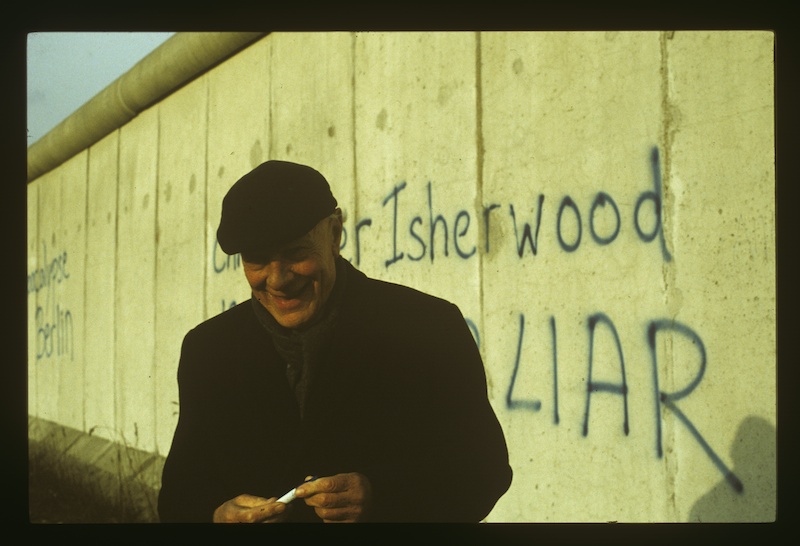
 Malcolm Muggeridge at the Berlin Wall, 1980.
Photograph © Robert Whitaker