
The Festival from India | Royal Festival Hall, London | 27 September 1968
Ravi Shankar (1920–2012)
On Friday, 27 September 1968, the celebrated Indian sitar virtuoso Ravi Shankar brought his Festival from India to London’s Royal Festival Hall. It was an important occasion in the growing international recognition of Indian classical music, bringing together an exceptional group of musicians under the direction of one of India’s most influential cultural ambassadors.
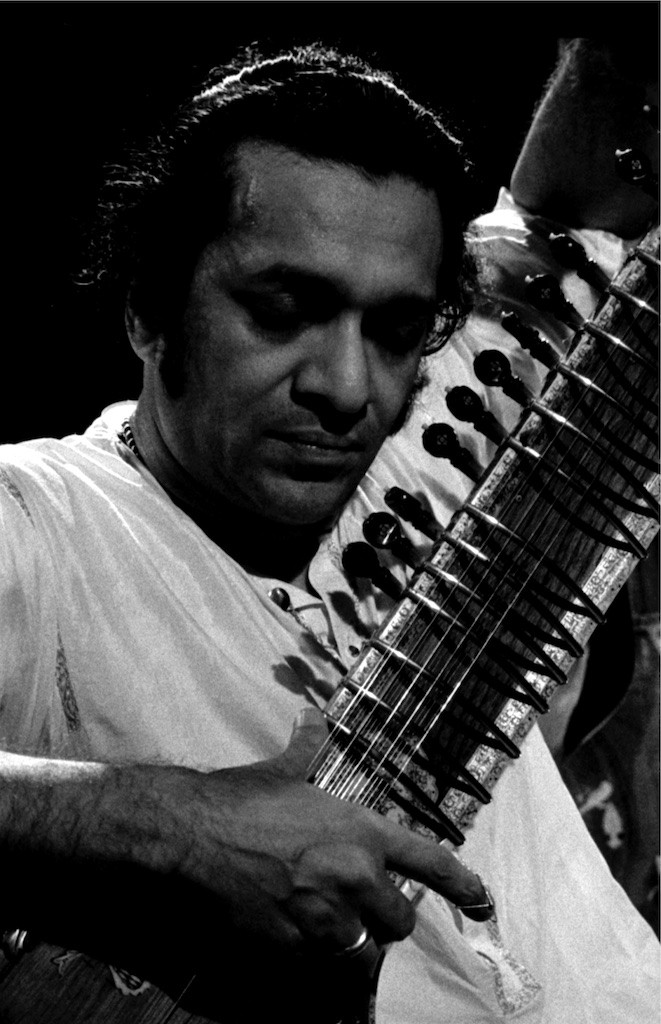
Robert Whitaker photographed Shankar during this performance, capturing an intimate portrait of the musician at work. Seated with his sitar, his attention fixed on the instrument, Shankar appears completely absorbed in the intricacies of his playing. The photograph offers a glimpse of the concentration and discipline behind an extraordinary musical tradition.
Born in Varanasi, India, on 7 April 1920, Shankar began his career touring Europe and America as a dancer and musician with his elder brother Uday Shankar’s troupe. In 1938, he abandoned the touring life to study sitar under the renowned musician Allauddin Khan in Maihar. This intensive traditional apprenticeship established the foundations of his remarkable musical career.
By the 1960s, Shankar had become an internationally recognised figure. His performances introduced Western audiences to Hindustani classical music, particularly the raga, a melodic framework developed through improvisation, and the tala, the intricate rhythmic cycles that underpin the music. His concerts could move from meditative, almost hypnotic passages to extraordinary displays of rhythmic complexity and virtuosity.
His growing association with Western musicians, most notably George Harrison of The Beatles, brought him to the attention of an entirely new generation. Harrison’s study of the sitar and his friendship with Shankar helped introduce Indian instruments and musical ideas into popular culture. Shankar, however, remained deeply committed to the discipline and integrity of Indian classical music.
The September 1968 London performance formed part of Shankar’s ambitious Festival from India, a showcase of Indian musical talent featuring an ensemble of accomplished performers whom he had brought to the West. Among them were his sister-in-law Lakshmi Shankar, a celebrated vocalist; Shivkumar Sharma on santoor; Sabri Khan on sarangi; Sharad Kumar on shehnai; and Palghat Raghu on mridangam. Alla Rakha, one of the great tabla players of his generation, was also among the accompanying musicians.
The performance was a considerable success. According to the Southbank Centre’s historical attendance records, the concert attracted an audience of 2,925, making it a major event in the Royal Festival Hall’s musical programme that year.
For Shankar, the Festival from India represented more than a series of concerts. It was an opportunity to present the extraordinary breadth of Indian musical traditions to international audiences, introducing performers and instruments that were still relatively unfamiliar outside the subcontinent.
His influence continued to grow over the following decades. In 1971, he collaborated with George Harrison on the Concert for Bangladesh at Madison Square Garden in New York, helping establish a new model for major international benefit concerts. He went on to receive numerous honours, including three Grammy Awards, and remained an active performer and composer until his later years.
Ravi Shankar died in San Diego on 11 December 2012, aged 92. His legacy extends far beyond his mastery of the sitar. He transformed the international understanding of Indian classical music and created a lasting musical dialogue between East and West.
Robert Whitaker’s photograph, taken at the Royal Festival Hall on 27 September 1968, documents a remarkable moment in that story: an artist at the height of his international influence, sharing one of the world’s great musical traditions with a new generation of listeners.