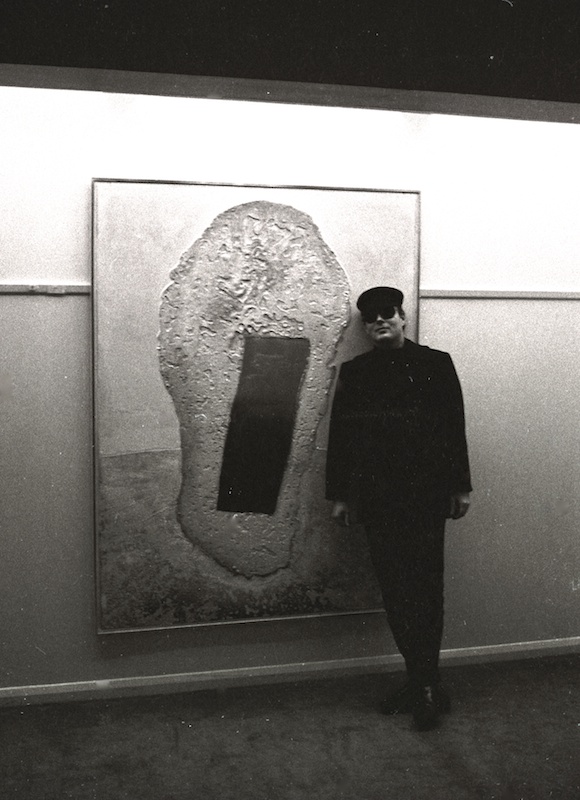
Asher Bilu is an artist whose work has continually explored the boundaries between painting, sculpture and installation. Born in Tel Aviv, Israel, in 1936, Bilu arrived in Australia in December 1956 and quickly established himself as an innovative figure within the country’s emerging modern art scene.
Robert Whitaker photographed Bilu in Australia in 1963, during an important early period in the artist’s career. At this time, Bilu was already developing a distinctive abstract visual language, experimenting with texture, colour, light and unconventional materials.
An emerging figure in Australian modern art
Bilu’s early career was characterised by experimentation and a determination to move beyond conventional approaches to painting. He did not follow a traditional academic route into the arts. Instead, he developed his techniques independently, drawing inspiration from artists such as Paul Klee and Antoni Tàpies.
His early paintings frequently explored cosmic and metaphysical themes, with unusual surfaces, complex textures and luminous colours. He experimented with materials including beeswax, raw pigments and resin, sometimes using water and fire to transform the painted surface. These methods helped create works that seemed to occupy a space between the two-dimensional world of painting and the physical presence of sculpture. media.artgallery.nsw.gov.au+1
By the early 1960s, Bilu was attracting attention from prominent Australian art critics and exhibiting in established galleries. His exhibitions included the Museum of Modern Art of Australia in Melbourne in 1962, followed by a London exhibition at the Rowan Gallery in 1963. His career was beginning to extend beyond Australia, with an exhibition in Rotterdam the following year. Asher Bilu+1
International recognition and artistic achievement
Bilu went on to become an influential figure in Australian contemporary art. In 1965, he won the prestigious Blake Prize for Religious Art, followed by the First Leasing Prize in 1970, one of Australia’s major art awards at the time. daao.org.au+1
His interest in pushing the boundaries of traditional art forms led to the creation of Sculptron I in 1967, described as the first electronic sculpture exhibited in Australia. He continued to develop large-scale installations, including Amaze(1982), Escape (1992), Mysterium (2003) and Heavens (2006). These works invited audiences to experience art as an immersive environment rather than simply something to observe. daao.org.au+1
Alongside his visual art, Bilu developed a creative relationship with filmmaker Paul Cox, working as production designer on several films, including Man of Flowers (1983), My First Wife (1984), Cactus (1986) and Human Touch (2005). His distinctive artistic vision helped bring an unusual visual dimension to Cox’s filmmaking. Asher Bilu+1
His work is represented in major Australian collections, including the National Gallery of Australia, the National Gallery of Victoria, the Art Gallery of New South Wales and the Museum of Contemporary Art in Sydney. daao.org.au+1
Robert Whitaker and Asher Bilu – 1963
Robert Whitaker’s photograph of Asher Bilu in Australia in 1963 documents an artist at an important moment in his early career.
It is particularly interesting to place the photograph within the context of Bilu’s artistic development. Having established himself in Melbourne through a series of exhibitions and critical recognition, he was beginning to gain international exposure. In 1963, he also exhibited at London’s Rowan Gallery, marking the beginning of a period of international activity.
Whitaker’s photograph therefore provides a visual record of a creative figure whose work would go on to make a significant contribution to Australian modern and contemporary art.