
Fire Base Carol
The fire power is amazingly heavy. High explosive shells stand in serried ranks round the guns, and according to photographer Bob Whitaker, they are pumped in a never ending stream towards the Vietcong strongholds in the jungle.
A Photographer on the Frontline
Four weeks in Vietnam and Cambodia, covering the conflict alongside South Vietnamese armoured forces. An extraordinary assignment that ended with Robert wounded and evacuated home.
In 1970, Robert Whitaker, the British photographer best known for his work with The Beatles, found himself covering one of the most dangerous conflicts in the world.
It was a remarkable departure from the music and entertainment assignments that had helped establish his reputation. This time, his surroundings were not recording studios, concert halls or hotel rooms, but the jungles, roads and battlefields of Southeast Asia.
His experiences were documented in an article published in the 10 July 1970 issue of LIFE magazine, titled “Four Photographers Go Jungle-Busting”.
The assignment brought together four photographers: two working in Vietnam and two in Cambodia, attempting to document the rapidly developing military operations and the human consequences of the conflict.
Into the battlefield
Robert was accompanying troops of the South Vietnamese Army’s 11th Armored Cavalry Regiment, travelling with armoured columns as they moved through the countryside and into Cambodia.
The 11th Armored Cavalry Regiment, commonly known as the Blackhorse Regiment, was one of the US Army’s principal armoured cavalry units in Vietnam.
It operated tanks, armoured cavalry assault vehicles (ACAVs), reconnaissance vehicles and supporting artillery.
Its role included:
- Reconnaissance and patrol operations.
- Protecting roads and military convoys.
- Engaging North Vietnamese Army and Viet Cong forces.
- Conducting operations in jungle and rubber plantation terrain.
- Supporting the Cambodian incursion in 1970.
The regiment crossed into Cambodia on 1 May 1970 as part of the US-led operation against North Vietnamese sanctuaries. Its operations included the advance towards Snoul and the search for enemy bases and supplies.
The conditions were exceptionally difficult. Military operations were moving quickly, communications were unreliable, and the photographers struggled to keep pace with advancing forces. Scenes of military action could appear and disappear almost as quickly as the columns themselves.
Robert was riding on a tank when disaster struck.
As he later recalled in the LIFE article:
“Bang,” he said. A rocket exploded on the gun turret and blew him to the ground.
He had been struck in the chest and thigh, although initially he did not realise how seriously he had been injured.
The incident brought his assignment to an abrupt end. After just four weeks in Vietnam, Robert was pale, gaunt and 24 pounds lighter. He was eventually flown home before he had even had the opportunity to develop his photographs.
The photograph behind the story
One of the most unusual aspects of the published account is the photograph accompanying Robert’s story.
Normally the person behind the camera, Robert had unexpectedly become the subject of a photograph himself.
The image published by LIFE, captioned “Wounded Whitaker”, shows him standing alongside two soldiers following the incident. According to the magazine, Robert’s camera had been picked up by a soldier, who took the photograph while Robert was being helped.
It is a rare and deeply personal image in the Whitaker archive, documenting not only the dangers he encountered but also an extraordinary moment in his own life.
An extraordinary chapter
Robert’s four weeks covering the conflict in Vietnam and Cambodia represent a relatively little-known chapter of his photographic career.
The assignment demonstrated a willingness to venture well beyond the familiar world of music and celebrity photography, placing himself in situations where the risks were very real.
His experience was captured in the pages of LIFE, one of the most influential photographic publications of the twentieth century.
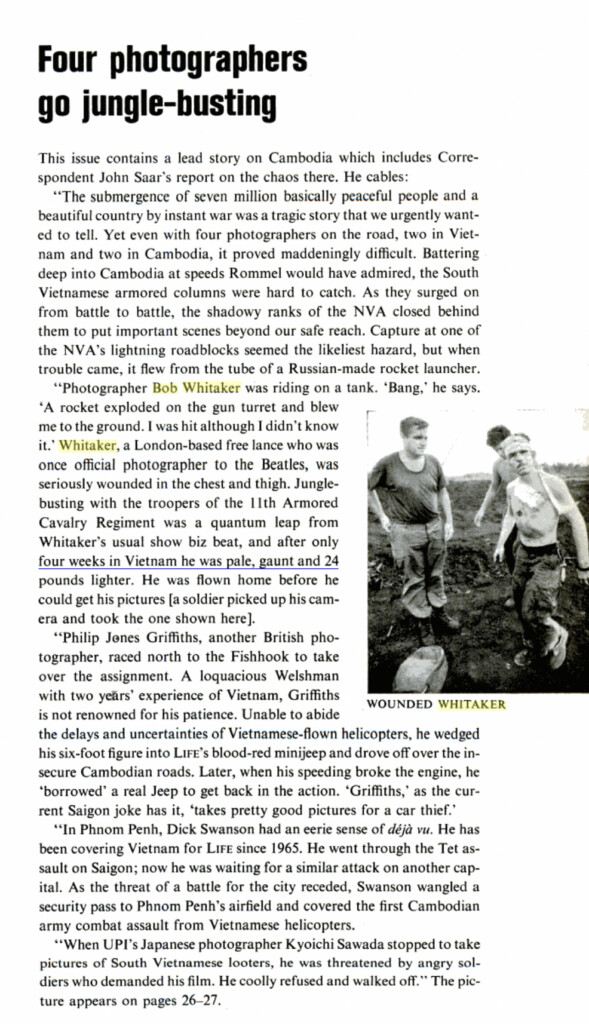
Original publication: LIFE magazine, 10 July 1970, Volume 69, Number 2.
Feature: “Four Photographers Go Jungle-Busting”.


