A Photographer in Melbourne’s Changing Art Scene
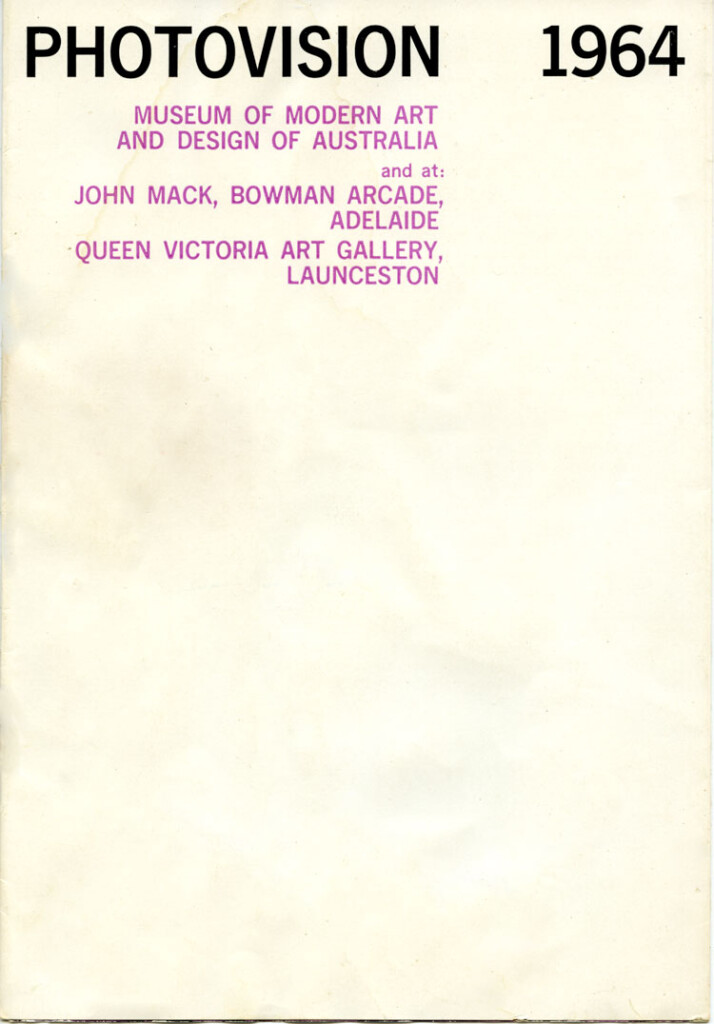
In June 1964, photographer Robert Whitaker was among the contributors to Photovision ’64, an important exhibition that formed part of Australia’s emerging movement to establish photography as a recognised art form.
Held at the Museum of Modern Art of Australia in Melbourne, the exhibition was organised by Group M, a collective of photographers committed to advancing photography beyond its traditional boundaries. It subsequently travelled to Bowman Arcade in Adelaide and the Queen Victoria Museum and Art Gallery in Launceston, Tasmania.
For Whitaker, then working as a professional photographer in Melbourne, participation in Photovision ’64 represented an important part of his Australian photographic career.
Melbourne: An emerging photographer
Whitaker arrived in Melbourne in 1961 and quickly became immersed in the city’s lively artistic and cultural community. He developed friendships with artists, writers and filmmakers, including Martin Sharp, Mirka Mora, Georges Mora and Nigel Buesst.
In 1963, Whitaker shared a photographic studio with Buesst. The two photographers were working in a period of considerable creative experimentation, when Melbourne’s artistic community was challenging established conventions and exploring new forms of visual expression.
Whitaker established his own studio in Flinders Lane in 1964, undertaking commercial, fashion, public relations and portrait photography. Alongside his professional assignments, he was developing a more experimental approach to photography, particularly through photomontage and darkroom techniques.
His participation in Photovision ’64 placed his work within a wider conversation about the artistic possibilities of photography in Australia.
Photovision ’64: A meeting of photographic perspectives
Group M had established Photovision as an annual exhibition, bringing together photographers from Australia and overseas. Its members believed that photography deserved greater recognition within the country’s artistic institutions.
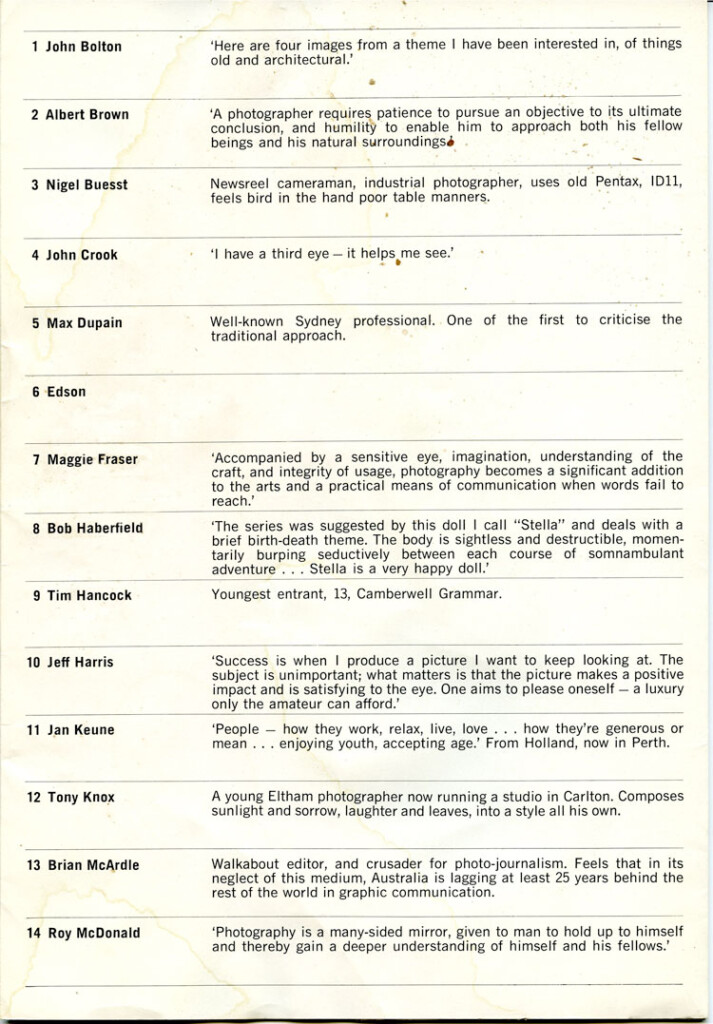
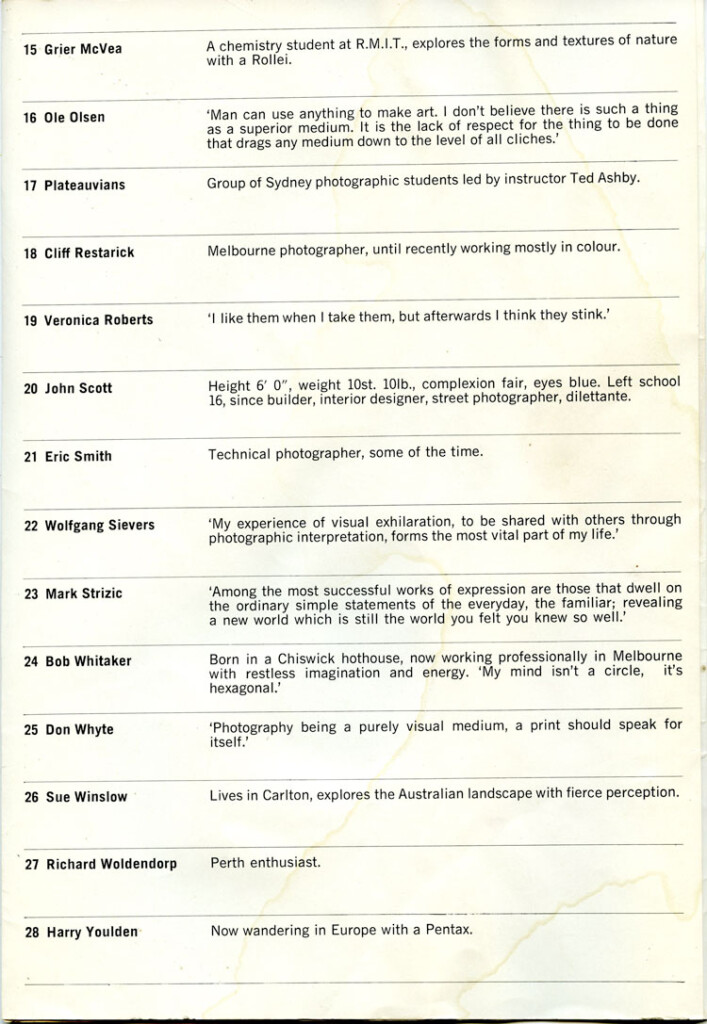
The 1964 exhibition included an impressive selection of photographers, among them Max Dupain, Wolfgang Sievers, Marc Strizic, David Moore, Nigel Buesst and Robert Whitaker.
The historical record of the exhibition is particularly significant for the Whitaker Archive. Philip Bentley’s 1996 Monash University thesis, Deeper Feeling, Wider Vision: Group M and the Moggs Creek Clickers, includes an appendix documenting Australian-based contributors to Photovision.
In this historical record, Robert Whitaker is explicitly listed as a contributor to the 1964 exhibition. Nigel Buesst is also recorded as a contributor. Both are identified in the appendix as Melbourne professionals.
The appendix records print contributions from Whitaker in both 1964 and 1965, providing documentary evidence of his participation in the Photovision exhibitions across two consecutive years.
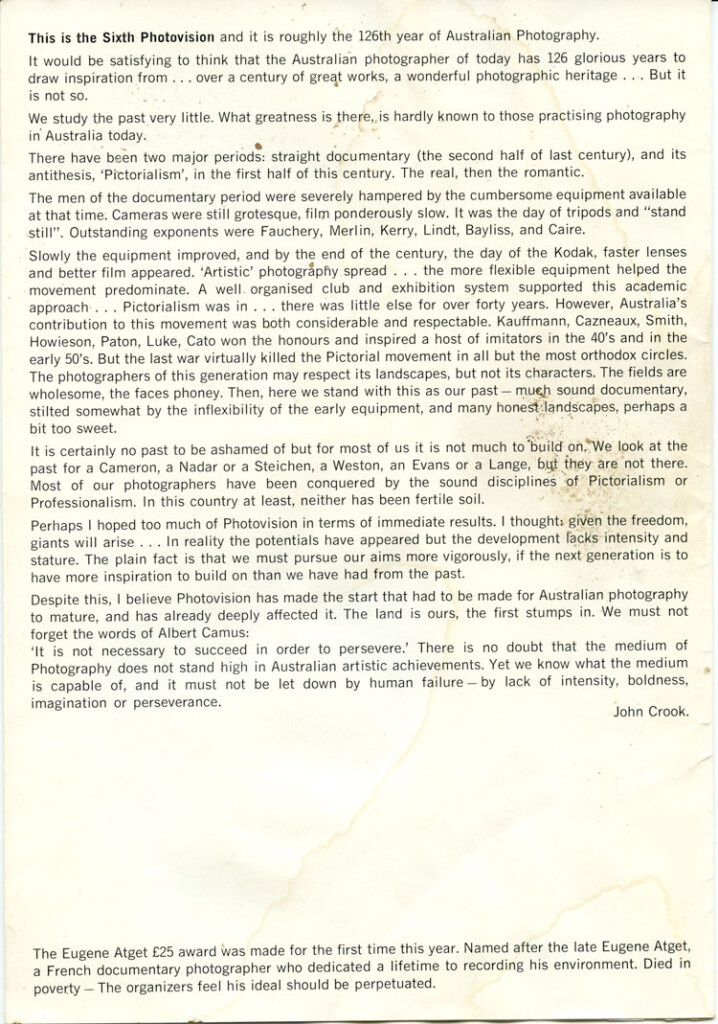
The 1964 exhibition also introduced the Eugene Atget Award, commemorating the French photographer whose extraordinary photographic record of Paris had established an enduring example of documentary photography.
The choice of Atget reflected the exhibition’s wider ambitions: to recognise photography as a serious medium capable of recording, interpreting and communicating the world around us.
An important year in Whitaker’s career
1964 was to become a defining year for Whitaker.
While continuing his photographic work in Melbourne, he came into contact with Brian Epstein, manager of The Beatles. Following a meeting arranged through a journalist friend at the Jewish News, Whitaker photographed Epstein and produced an imaginative photographic portrait that impressed the music entrepreneur.
Epstein subsequently saw Whitaker’s exhibition work at Melbourne’s Museum of Modern Art and offered him a position as staff photographer and artistic adviser to NEMS Enterprises.
Whitaker accepted the opportunity and returned to England in August 1964, beginning a new chapter in what would become an extraordinary international photographic career.
He went on to photograph The Beatles extensively, producing some of the most recognised images associated with the band, alongside portraits of musicians, artists and cultural figures of the 1960s.
His departure from Melbourne marked the end of an important period in his development as a photographer, but his Australian experiences remained an integral part of his artistic identity.
Preserving the Australian chapter
Photovision ’64 provides an important reference point in understanding Robert Whitaker’s development before his internationally recognised work with The Beatles.
His inclusion in the exhibition records places him alongside some of Australia’s most respected photographic practitioners of the period. It also establishes a documented connection between Whitaker, Nigel Buesst and the wider Melbourne photographic community of the early 1960s.
Much of the attention given to Whitaker’s career has understandably centred on his photographs of The Beatles and the international music scene. However, his earlier years in Melbourne reveal a photographer already exploring the boundaries between commercial photography, artistic experimentation and visual storytelling.