In 1971, Robert Whitaker travelled to Northern Ireland on assignment for TIME magazine to document a conflict that was rapidly transforming everyday life across the province. What became known as the Troubles was entering one of its most turbulent and violent periods, with political tensions, sectarian divisions and armed confrontation increasingly shaping the lives of ordinary people.
The conflict had its roots in decades of political and religious division, discrimination against the Catholic nationalist community, and competing aspirations over Northern Ireland’s constitutional future. By 1971, the situation had deteriorated dramatically. The Provisional Irish Republican Army (IRA) had intensified its armed campaign against British rule, while loyalist paramilitary organisations and British security forces were becoming increasingly involved in the escalating violence.
A defining moment came on 9 August 1971, when the Northern Ireland government introduced internment without trial. The policy allowed suspected republican paramilitaries to be detained without charge and was initially directed almost exclusively at the Catholic community. The resulting arrests, protests and confrontations intensified hostility towards the British authorities and contributed to a further escalation of violence.
Whitaker’s assignment took him into communities where the conflict was not simply a matter of politics or military strategy, but an everyday reality. His photographs provide a record of streets, neighbourhoods and people living in the shadow of an increasingly militarised society.
A photographer’s view of the conflict
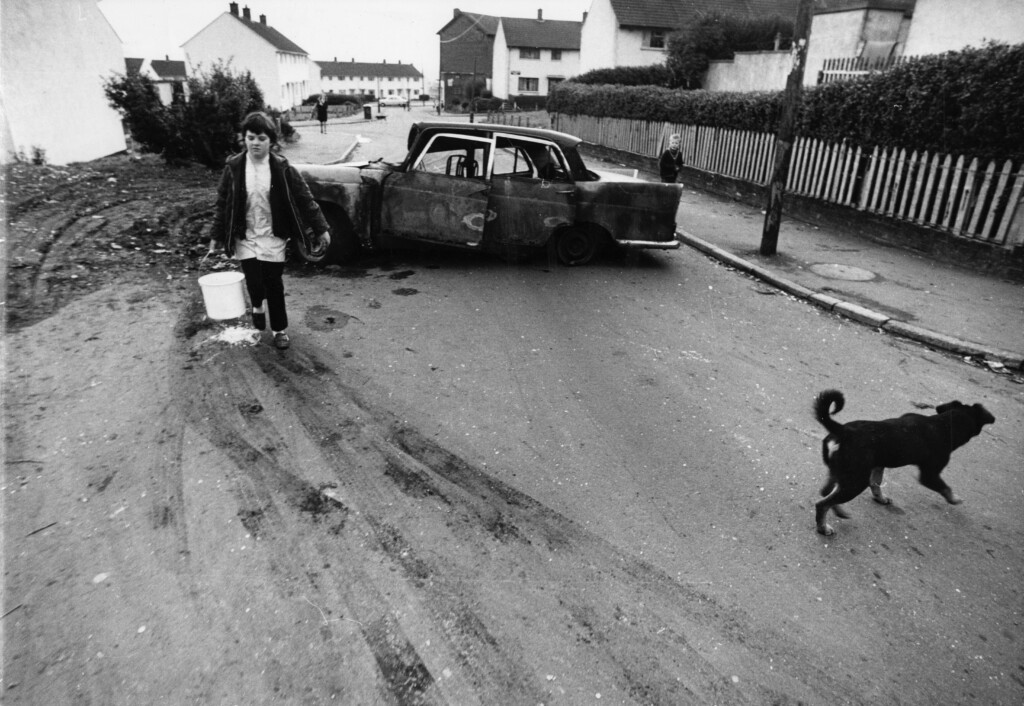
In West Belfast, Whitaker photographed the ordinary rhythms of neighbourhood life against a backdrop of destruction and uncertainty. One image shows a young girl carrying a bucket past a burned-out car, a striking contrast between the innocence of childhood and the physical evidence of the violence surrounding her. The residential streets and surrounding hills provide a sense of place, while the child’s everyday activity offers a reminder that life continued even as communities were caught up in the conflict.
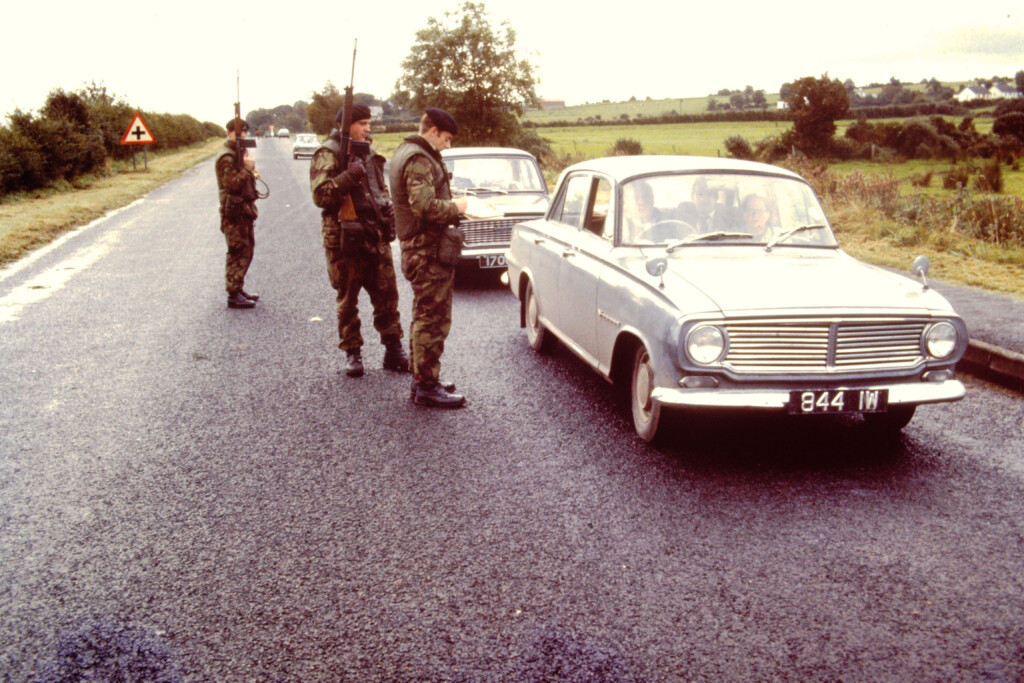
Other photographs document the British Army’s presence beyond the urban centres. Along a rural road, a military vehicle stops a civilian car at a checkpoint. Such encounters had become an increasingly familiar feature of life in Northern Ireland, as security forces sought to control movement and counter the activities of republican paramilitary groups, particularly near the border with the Republic of Ireland.
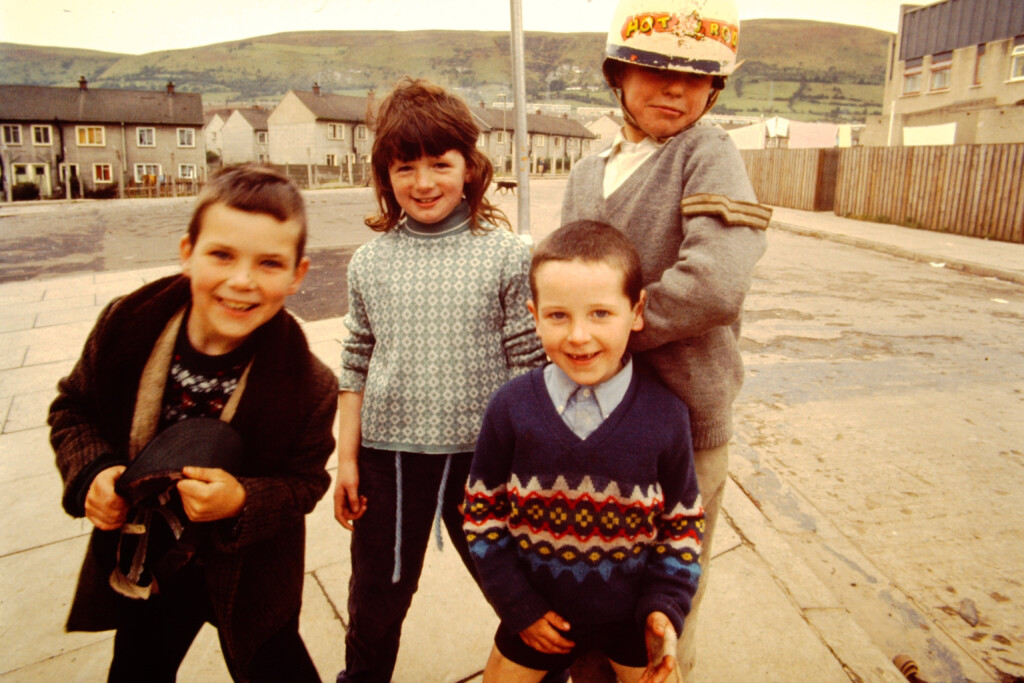
In another photograph, local children pose in front of a residential housing scheme, with the Belfast Hills rising behind them. The image is particularly revealing: despite the political and sectarian divisions that dominated the headlines, these were communities where families continued to live, children played and ordinary routines persisted.
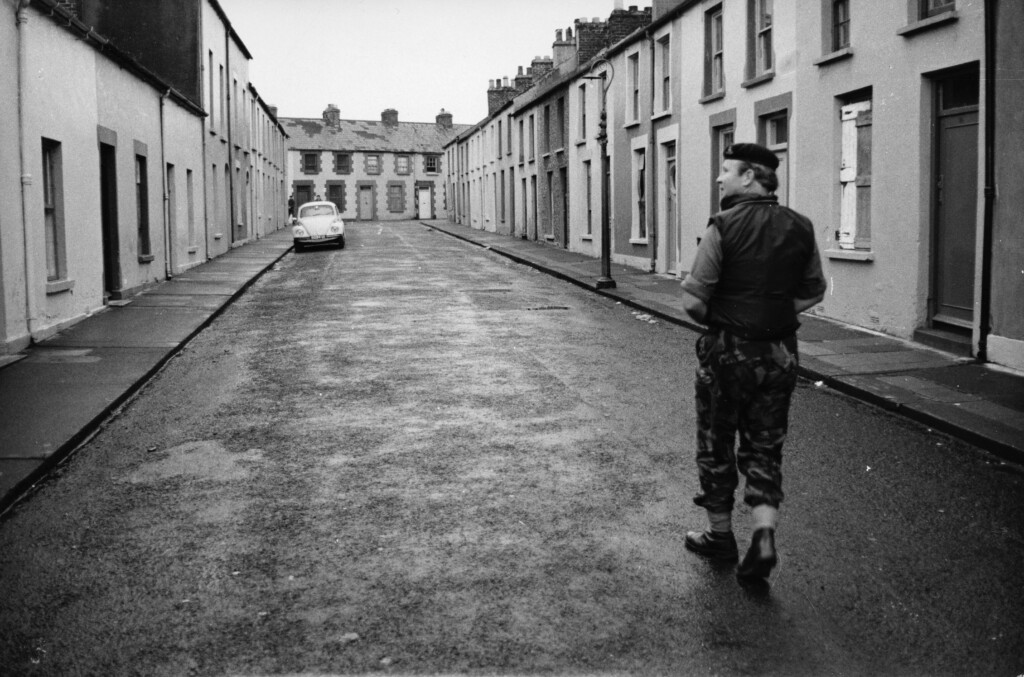
In Derry, Whitaker turned his camera towards the narrow terraced streets of the city, where British soldiers patrolled residential neighbourhoods. The military presence in areas such as the Bogside and Creggan was a visible expression of the growing confrontation between the British authorities and nationalist communities.
These were not simply photographs of soldiers, checkpoints and damaged streets. They were photographs of people living through a period of profound uncertainty, where the boundaries between civilian life and political conflict were becoming increasingly difficult to separate.
1971: A year of escalation
The introduction of internment in August 1971 marked a major turning point. Hundreds of men were arrested in the initial raids, and the policy was overwhelmingly directed at the Catholic nationalist community. The arrests provoked widespread protests, civil disobedience and violent confrontations. Thousands of people were subsequently displaced from their homes.
The Provisional IRA’s campaign continued to intensify, while loyalist paramilitary violence and the actions of the security forces contributed to an increasingly dangerous environment. The following year would bring further tragedy, most notably Bloody Sunday in Derry on 30 January 1972, when British soldiers shot civil rights demonstrators, killing thirteen people on the day and another man who later died of his injuries.