
The photographs Robert Whitaker took of the Bee Gees during 1967 and 1968 preserve an important chapter in the history of one of popular music’s most successful groups. Taken at a time when Barry, Robin and Maurice Gibb were moving from Australian success towards international recognition, they document the brothers during the early stages of a career that would eventually span more than five decades.
Robert photographed the group during recording sessions at London’s IBC Studios, while they were making a promotional film for To Love Somebody, and later during their promotional activities in and around Los Angeles. His photographs capture the Bee Gees not simply as emerging pop stars, but as five young musicians navigating an extraordinary period of musical and cultural change.
One of Robert’s photographs would eventually find an entirely new audience more than fifty years later, when it was selected for the artwork of the 2018 reissue of the Bee Gees’ early Australian album Spicks and Specks.
To understand the significance of these photographs, it is worth returning to the beginning of the story.
Spicks and Specks – The beginning in Australia, 1966
The origins of the Bee Gees’ international success can be traced to Australia in 1966.
Barry, Robin and Maurice Gibb had emigrated from Britain with their family in 1958, settling initially in Queensland. During the following years, they developed their musical careers through radio appearances, television performances and recordings, gradually establishing themselves as one of Australia’s most promising young groups.
Working with Australian producer Nat Kipner and recording at Ossie Byrne’s St Clair Studio in Hurstville, Sydney, the brothers began developing the songwriting and vocal harmonies that would become their trademark.
The breakthrough came with Spicks and Specks, written principally by Barry Gibb and recorded in Australia during July 1966.
Released as a single in September 1966 on the Spin label, the song became the group’s first major Australian hit. Its memorable piano introduction, expressive melody and distinctive vocal arrangement demonstrated the brothers’ growing confidence as songwriters.
The success of the single prompted the release of their second Australian album, also titled Spicks and Specks, in November 1966. Originally intended to be called Monday’s Rain, the album was renamed to capitalise on the popularity of the hit single.
The album is an important document of the group’s early development, containing songs that reveal a very different musical identity from the orchestral pop of their later British recordings.
By the time Spicks and Specks was becoming a major success, however, the Gibb family had already decided to return to England in search of greater opportunities.
They sailed from Australia in January 1967, accompanied by their musical associate Ossie Byrne. During the journey, news reached them that Spicks and Specks had been recognised by Australian music publication Go-Set as the best single of 1966.
The timing was extraordinary. The record that had finally established their Australian reputation was becoming a hit just as they were leaving the country to pursue an international career.
Britain, 1967 – A new beginning
The move to England would transform the Bee Gees’ fortunes.
Robert Stigwood, an Australian-born music entrepreneur who had become associated with Brian Epstein’s NEMS organisation, had heard recordings sent ahead by the Gibb family. Impressed by their songwriting and vocal harmonies, he arranged to meet the brothers shortly after their arrival.
On 24 February 1967, Stigwood signed the Bee Gees to a five-year management agreement.
The group was also expanding. Australian drummer Colin Petersen and guitarist Vince Melouney joined Barry, Robin and Maurice, creating the five-member line-up that Robert would photograph during the following two years.
The brothers began working on new material in London, initially making demonstration recordings before moving into professional recording sessions at IBC Studios in Portland Place.
Their first British-recorded single, New York Mining Disaster 1941, was released by Polydor in April 1967. Its unusual subject matter, haunting melody and intricate harmonies immediately distinguished the group from many of their contemporaries.
The single reached number 12 in Britain and number 14 in the United States, providing the foundation for their international breakthrough.
It was the beginning of a remarkable sequence of recordings that would establish the Bee Gees as one of the leading songwriting groups of the late 1960s.
IBC Studios, Portland Place – Recording To Love Somebody
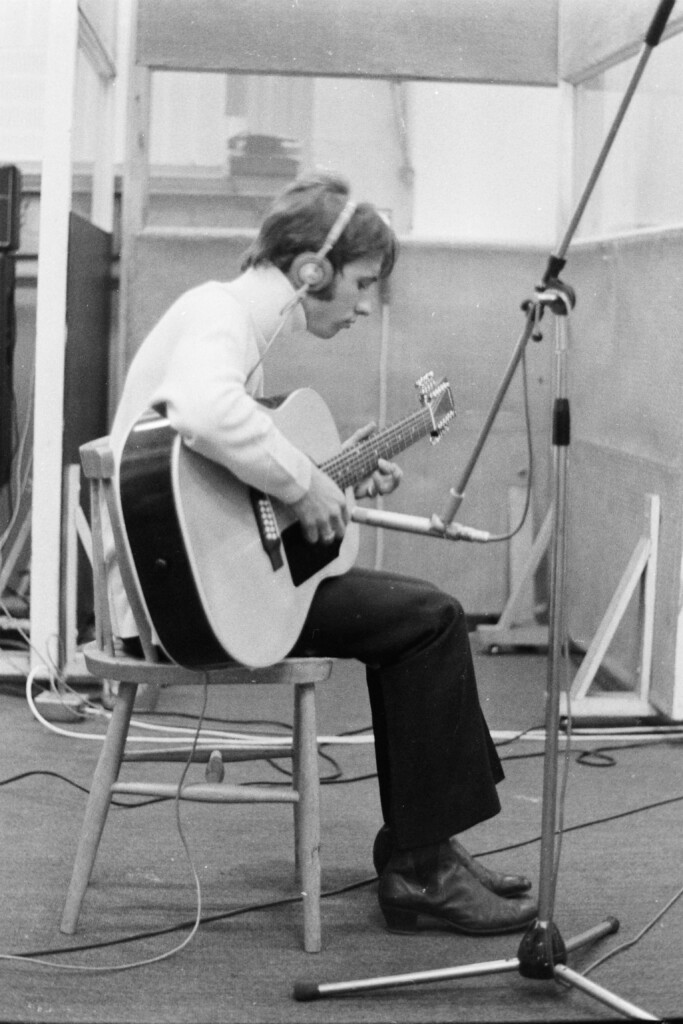
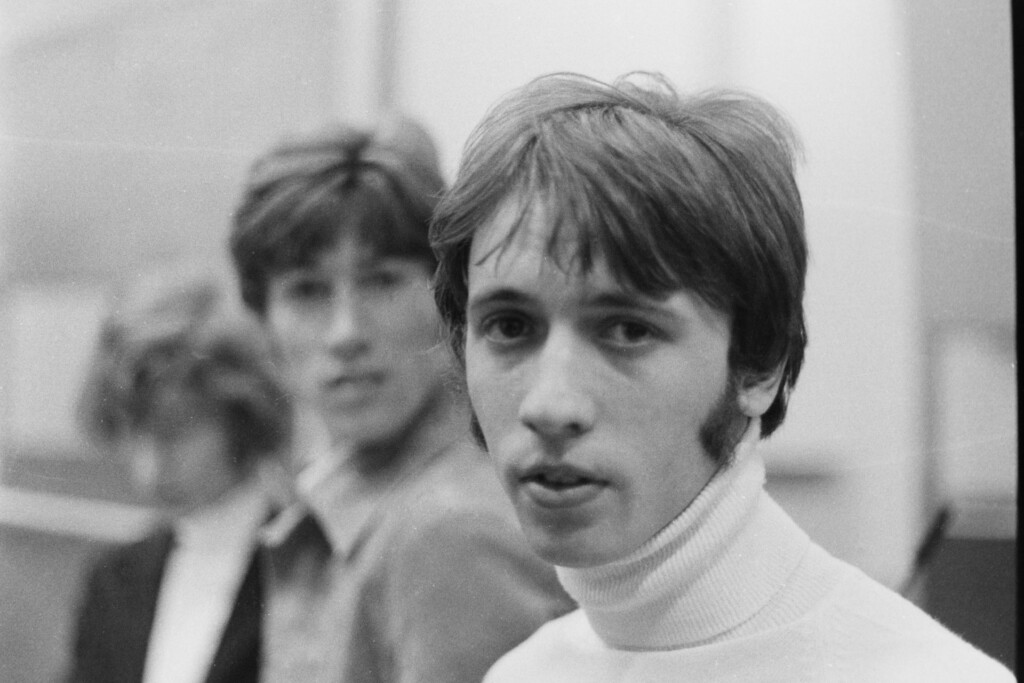
One of the most important parts of Robert’s photographic documentation concerns the Bee Gees at IBC Studios in London’s Portland Place.
IBC was one of the significant recording centres of the British music industry during the 1960s. It was here that the Bee Gees began recording the material that would form their first international album, Bee Gees’ 1st.
Robert’s photographs include images of Robin Gibb during a recording session, capturing him in the working environment of the studio rather than in a conventional publicity setting.
The recording sessions brought together the three brothers, Colin Petersen and Vince Melouney, with Robert Stigwood and Ossie Byrne involved in production and Bill Shepherd responsible for many of the orchestral arrangements.
The atmosphere was one of considerable creative activity. Barry, Robin and Maurice were writing constantly, developing their distinctive harmonies and experimenting with more ambitious arrangements and recording techniques.
Among the material recorded during this period was To Love Somebody, written by Barry and Robin Gibb.
The song was originally conceived with American soul singer Otis Redding in mind. Barry had admired Redding’s music and hoped he might record it. Instead, the Bee Gees released their own recording in June 1967, with Barry singing lead.
It became one of the most enduring compositions in the group’s catalogue.
The combination of Barry’s expressive vocal, the brothers’ harmonies and the emotional intensity of the arrangement demonstrated that the Bee Gees were capable of creating music that reached well beyond conventional pop.
Robert’s photographs of the group at IBC preserve an important visual record of this creative period, documenting the musicians as they were establishing the sound that would bring them international recognition. Robert Whitaker Photography+2
To Love Somebody – The promotional film, May/June 1967
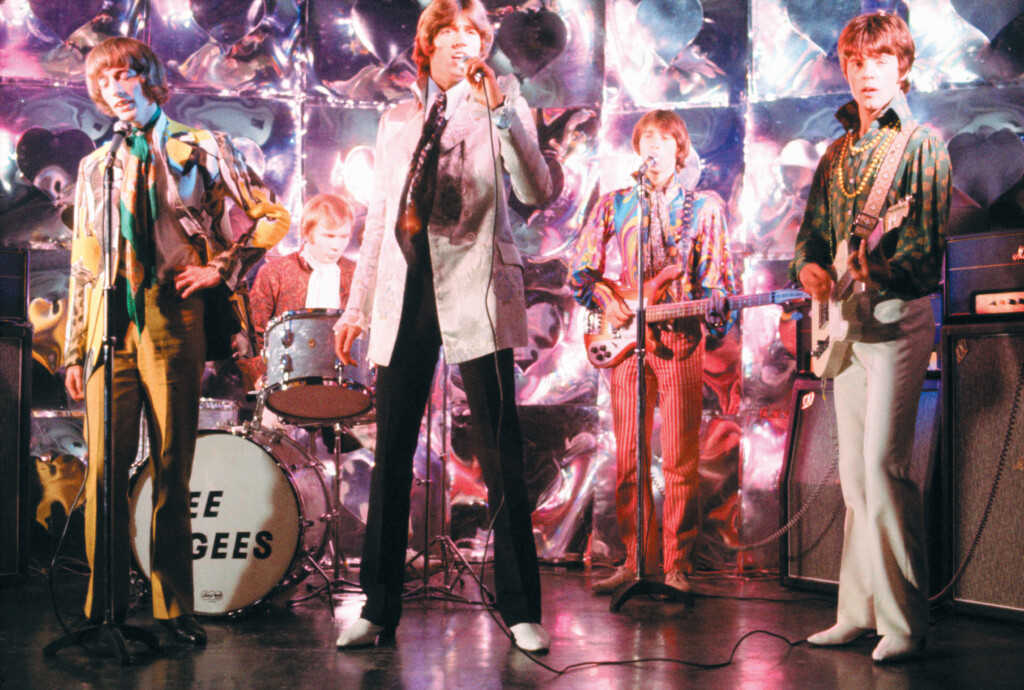
Robert also photographed the Bee Gees during the filming of a promotional film for To Love Somebody in May and June 1967.
These images are among the most visually interesting photographs in the collection. The group appear in their colourful clothing, reflecting the emerging psychedelic aesthetic that was becoming increasingly prominent in London.
The photographs feature Barry, Robin and Maurice alongside Colin Petersen and Vince Melouney, capturing the complete five-member group during a formative period.
The use of promotional films was becoming increasingly important in the music business. Before the modern music video became an established part of the industry, short films offered record companies a way to promote their artists to television stations and international audiences without requiring the musicians to be physically present.
The Bee Gees were particularly well suited to this new form of promotion. Their appearance, distinctive clothing and carefully constructed musical identity gave them a strong visual presence.
The promotional filming also coincided with the release of Bee Gees’ 1st in July 1967, an album that established the group as an important new force in British and international pop.
The album included New York Mining Disaster 1941, To Love Somebody, Holiday, I Can’t See Nobody and Every Christian Lion Hearted Man Will Show You.
Robert’s photographs preserve the group at precisely the moment when their musical and visual identities were coming together.
The photograph that found a second life
One image from this 1967 photographic period would eventually become particularly significant to the archive.
More than fifty years after Robert took it, the photograph was selected as the basis for the cover artwork of a new edition of Spicks and Specks in 2018.
It is a remarkable example of an image finding a new purpose long after the original photographic sitting.
The Bee Gees on television – Top of the Pops, 1967
During 1967, the Bee Gees were also establishing themselves on British television.
Their first appearance on the BBC’s Top of the Pops took place on 11 May 1967, when they performed New York Mining Disaster 1941. The programme was an important platform for emerging British and international artists, and an appearance could introduce a new group to millions of viewers.
The Bee Gees’ television appearances coincided with their growing popularity and the success of their first British recordings.
Robert’s photographic collection includes images associated with the group’s television and promotional activities during this period. These should be considered alongside his studio and promotional-film photographs as part of the wider visual record of their emergence.
It is worth distinguishing the surviving television footage from Robert’s own photographs: the precise setting of individual archive images should be established from their original captions and negatives rather than assuming that every performance-related photograph was taken on Top of the Pops.
A remarkable year – The Bee Gees in 1967
By the second half of 1967, the Bee Gees were enjoying considerable international success.
Massachusetts, released in September, became their first British number-one single. It was followed by further recordings that demonstrated the brothers’ extraordinary songwriting ability.
Their first international album, Bee Gees’ 1st, was particularly important. It established the group’s musical identity, combining intricate vocal harmonies with orchestral arrangements, psychedelic influences and imaginative storytelling.
The songs that followed would become some of the most recognisable recordings of their early career:
- To Love Somebody
- Massachusetts
- World
- Words
- I’ve Gotta Get a Message to You
- I Started a Joke
What distinguished the Bee Gees was the fact that they were not simply performers of other people’s material. Barry, Robin and Maurice were prolific songwriters, capable of creating songs that were immediately recognisable as their own.
Their work during this period laid the foundations for a career that would eventually see them sell more than 120 million records worldwide.
For Robert, photographing the group during 1967 meant documenting them at the beginning of that extraordinary transformation. National Portrait Gallery+2
Los Angeles, 1968 – Taking the Bee Gees to America
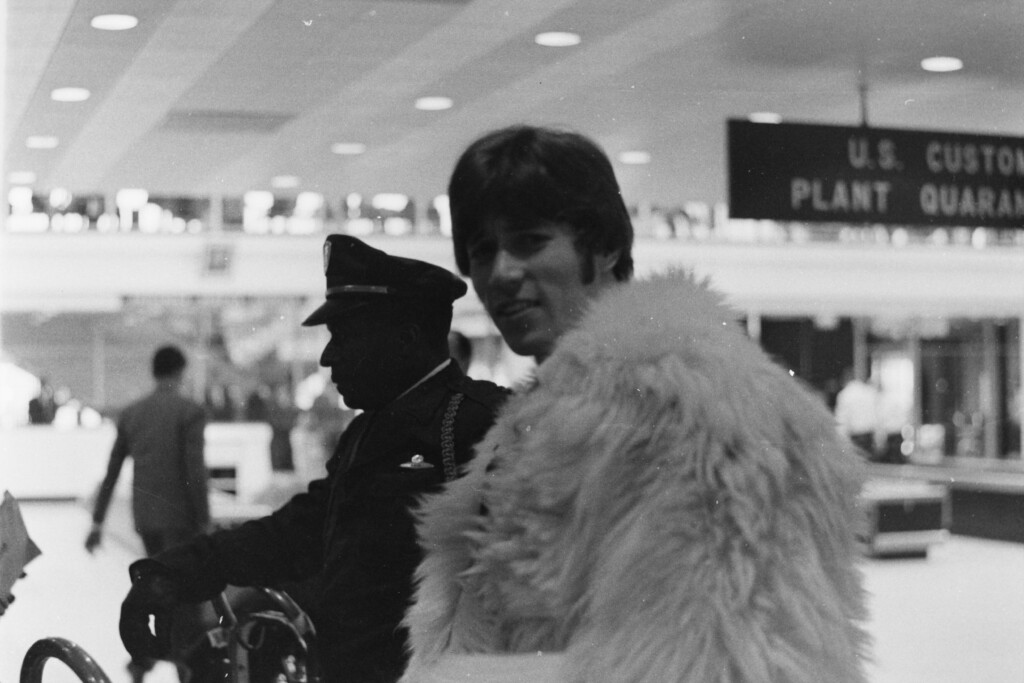
In 1968, Robert travelled to Los Angeles, where he photographed the Bee Gees during their promotional activities in and around the city.
His photographs show the group at a different stage of their development. The young Australians who had arrived in England only a year earlier were now becoming established international recording artists, undertaking promotional visits and building their American audience.
The photographs include Barry, Robin and Maurice Gibb alongside Colin Petersen and Vince Melouney.
One particularly interesting image shows Barry Gibb following his arrival at Los Angeles International Airport (LAX), providing a glimpse of the group’s increasingly international schedule.
These photographs form a natural continuation of Robert’s earlier London work. Having documented the Bee Gees in recording studios and during promotional filming, he was now recording their growing presence in the United States.
The Colorado Street Bridge, Pasadena
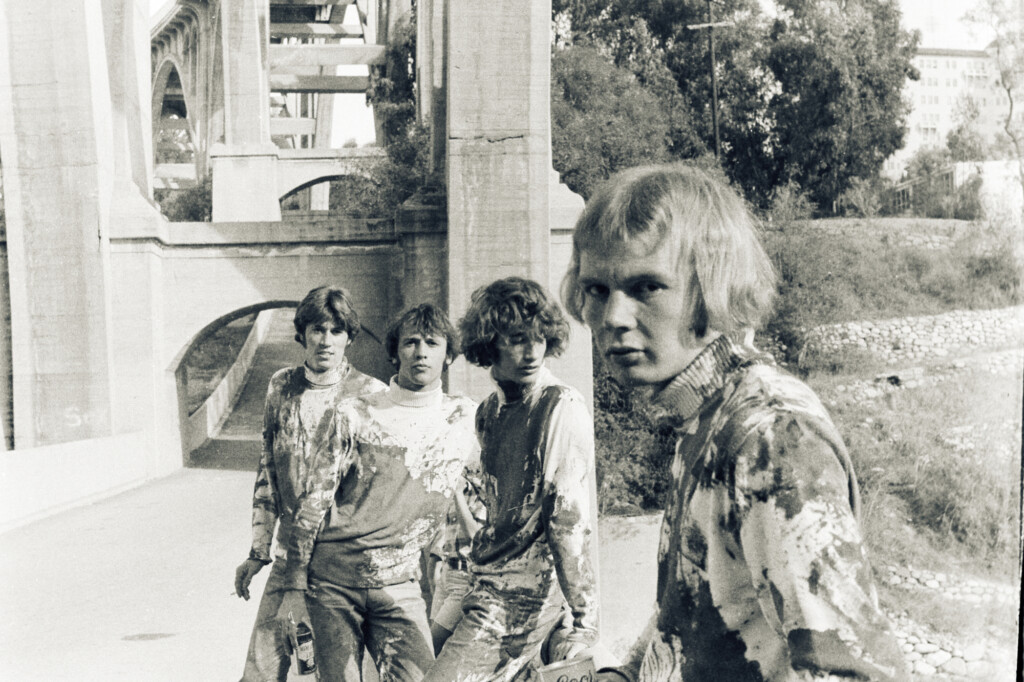
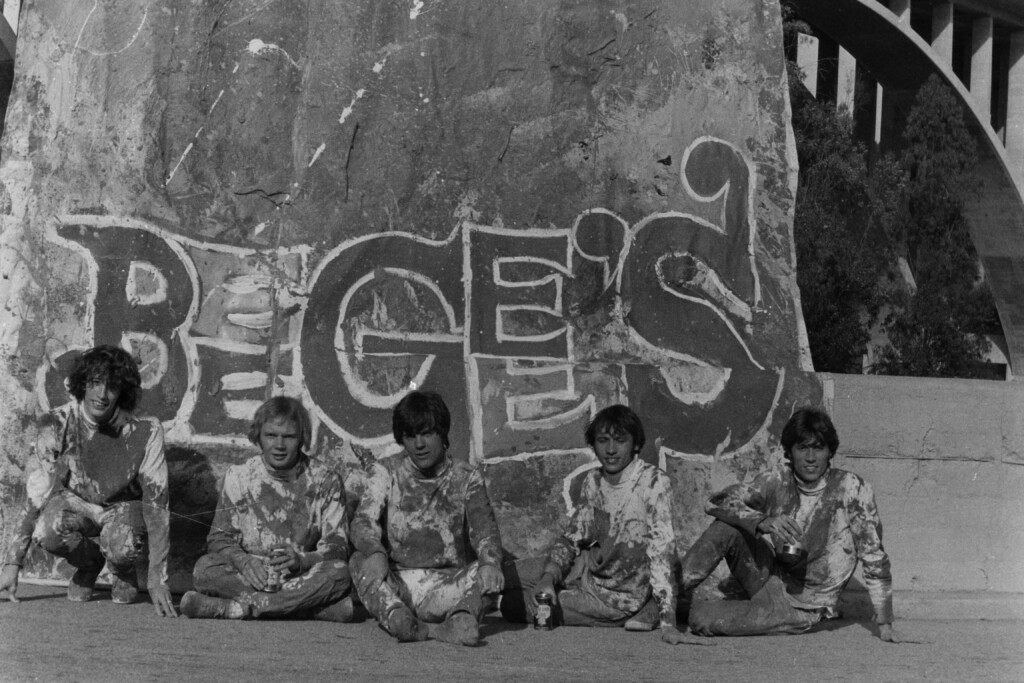
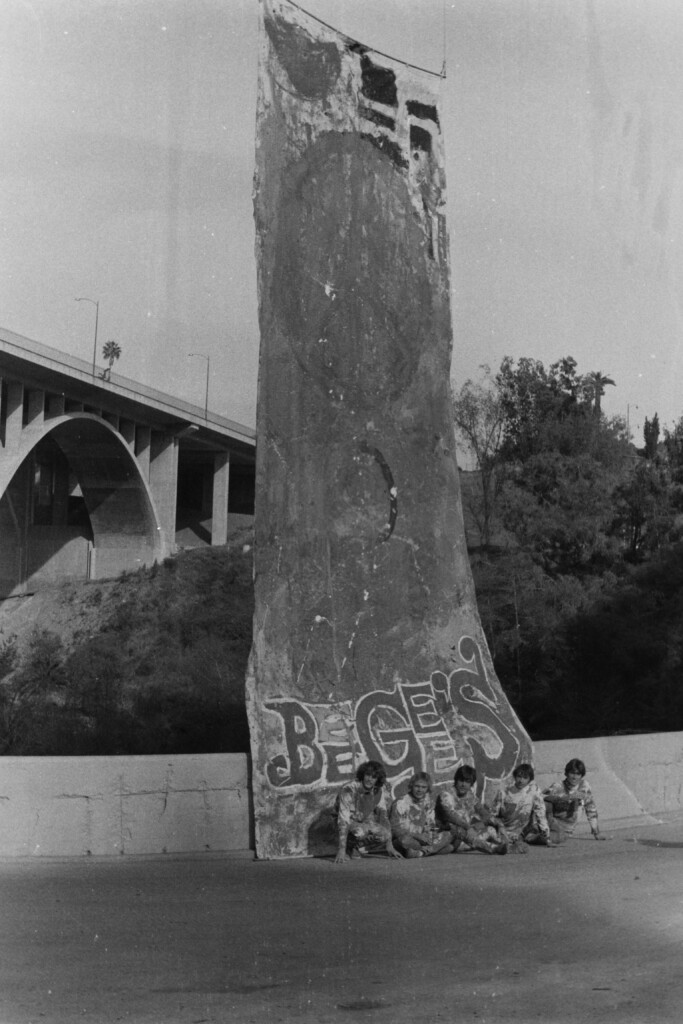
Among the most distinctive photographs from Robert’s Los Angeles period are the images of the Bee Gees at the Colorado Street Bridge in Pasadena, California.
The bridge, although often associated with Los Angeles, is actually situated in Pasadena, approximately ten miles northeast of downtown Los Angeles. Completed in 1913, it spans the Arroyo Seco and is recognised for its impressive concrete arches, ornate balustrades and decorative street lamps.
Standing approximately 150 feet above the ravine, the bridge was an important feat of early twentieth-century engineering and had become one of Southern California’s most recognisable architectural landmarks.
It provided an unusual and visually striking setting for Robert’s photographs of the Bee Gees.
Rather than photographing the group in a conventional studio or publicity environment, Robert used the architecture and surrounding landscape to create images that capture something of the atmosphere of California during the late 1960s.
The photographs show the group away from the recording studio and concert stage, providing a more relaxed perspective on the musicians during their American visit.
The series is an important addition to the archive because it documents not only the Bee Gees themselves but also the places and environments through which Robert encountered them.
Spicks and Specks – A photograph rediscovered, 2018
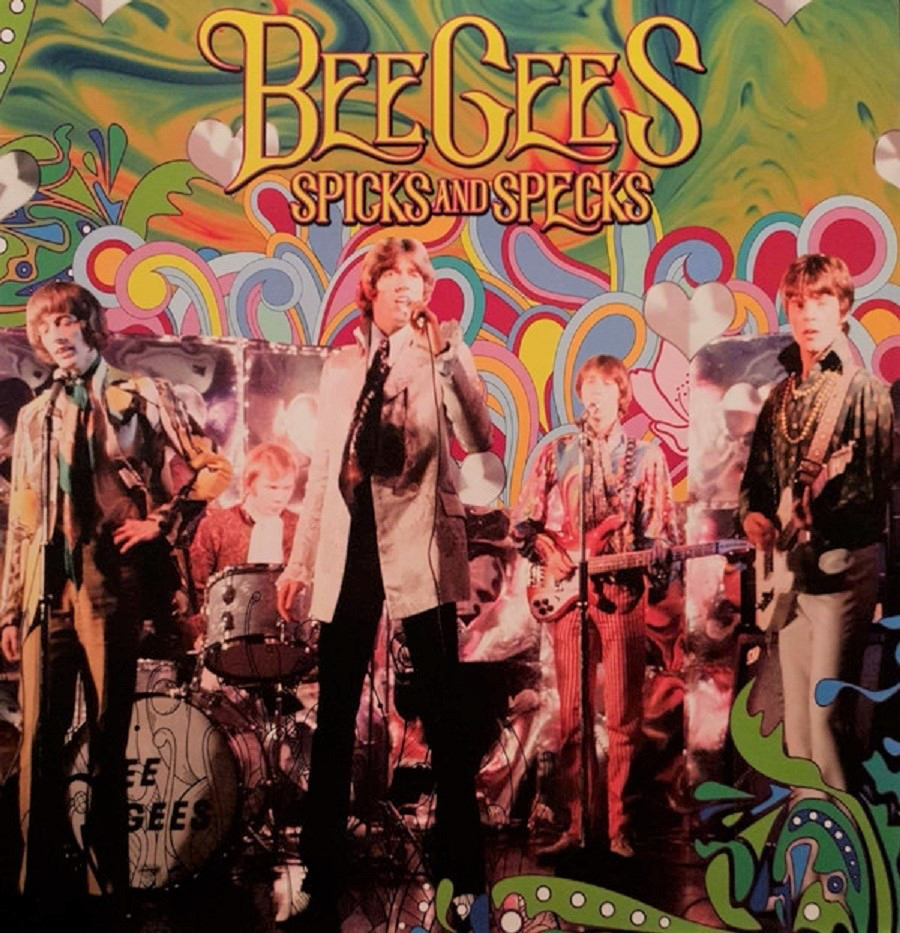
Perhaps the most interesting later chapter in the story of Robert’s Bee Gees photographs concerns the 2018 reissue of Spicks and Specks.
More than fifty years after Robert took the original photograph, one of his images was selected for the cover artwork of a new European edition of the album, released by Interhit Records.
The photograph shows the complete five-member Bee Gees line-up of the period: Barry, Robin and Maurice Gibb, Colin Petersen and Vince Melouney.
It was originally taken during Robert’s 1967 photographic work with the group, associated with the promotional filming for To Love Somebody at IBC Studios in London’s Portland Place.
The choice of photograph was particularly appropriate. Although Spicks and Specks had originally been released in Australia in 1966, the image captured the group as they appeared during the period immediately following their move to Britain.
The new artwork was created by Romanian graphic designer Andrei Mignea, who was commissioned to reinterpret the original photograph.
Andrei Mignea’s psychedelic interpretation
Mignea approached the project as an opportunity to bring together the visual language of the 1960s with a contemporary interpretation of psychedelic design.
The original photograph was supplied for the project, but it required considerable restoration before it could be used.
In a later account of the project, Mignea explained that the scanned image contained dust, hair and other imperfections. The upper part of the photograph had also been cropped, cutting off the top of Barry Gibb’s head, which he had to reconstruct by hand.
The designer explored the graphic styles associated with the psychedelic era, particularly the colourful poster traditions of San Francisco’s Fillmore scene and London’s underground art movement.
He wanted the final artwork to reflect the period in which the photograph had been taken, while giving the album a fresh visual identity.
The project also involved obtaining the necessary photographic and music-related permissions, with discussions involving Barry Gibb and the estates of Robin and Maurice Gibb.
Mignea subsequently described the commission as an honour, explaining that he had grown up listening to the Bee Gees and was delighted to become involved in a project associated with such an important group.
The finished artwork was announced in April 2018, with the release scheduled for 8 June 2018.
The European reissue appeared on Interhit Records in both CD and vinyl formats. The vinyl retained the original twelve-track album, while the CD edition included five additional recordings, bringing the total to seventeen tracks.
The original music remained that of the 1966 Australian album, but Robert’s photograph gave the reissue a completely new visual identity.
It is particularly satisfying that a photograph made during the group’s early British career should eventually become the defining image of a new edition of the album that had helped set their international journey in motion. Robert Whitaker Photography+3
The importance of the five-member line-up
An important aspect of Robert’s Bee Gees photographs is that they document the group as a five-member band.
While the three Gibb brothers naturally remain the central figures in the group’s history, Colin Petersen and Vince Melouney played important roles during this formative period.
Colin Petersen, an Australian drummer and former child actor, had known the brothers during their Australian years. His drumming became an important part of the Bee Gees’ early recordings and live performances.
Vince Melouney, also Australian, joined as guitarist and contributed to the band’s developing musical identity.
Both musicians were part of the group during the recording of Bee Gees’ 1st and Horizontal.
Robert’s photographs preserve this particular line-up, which is especially significant when viewed alongside the later history of the band.
The 2018 Spicks and Specks cover is a good example: rather than showing only the three famous brothers, it presents the complete group as they appeared during their early international years.
Research and further reading
The following sources are particularly useful for supporting the historical information and the photographic provenance:
- Robert Whitaker – Official Biography – Robert’s own archive chronology, including his 1967 and 1968 Bee Gees work and the photograph used on Spicks and Specks.
- The Very Very Beginning of the Bee Gees – official Bee Gees history of their Australian beginnings, move to England and signing with Robert Stigwood.
- Bee Gees – Spicks and Specks – official album history and recording background.
- Gibb Songs – 1967 – detailed recording-session chronology for the early British recordings.
- Andrei Mignea and the 2018 Spicks and Specks artwork – research into the designer’s creative process, photograph restoration and licensing discussions.
- Robert Whitaker and the Bee Gees photographs – Martha Colmenares – additional research into the rediscovered photographs and their subsequent use.
- MusicBrainz – 2018 Spicks and Specks reissue – release information and cover-art catalogue.
- National Portrait Gallery – The Bee Gees – biographical and historical background.