
Stockholm, New York, London, Ibiza, Paris and San Francisco – 1960s and 1970s
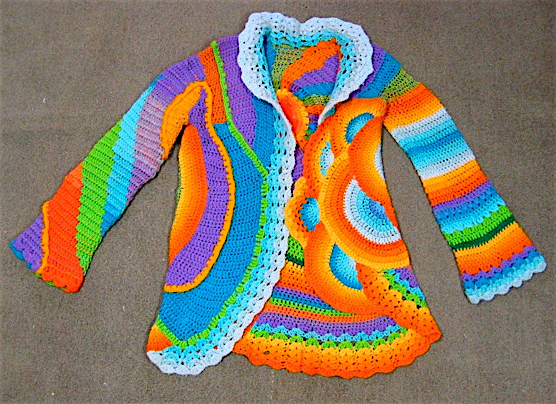
The career of Swedish-born artist and designer Birgitta Bjerke, who worked under the name 100% Birgitta, is a remarkable story of creativity, independence and constant reinvention.
Moving between Stockholm, New York, London, Paris, Ibiza and San Francisco, Bjerke developed an unusually diverse career encompassing fashion design, experimental crochet, stage costumes, record-cover artwork, murals, wearable art, restaurant design and film costume work.
Her story also provides an interesting connection to Robert Whitaker and the international artistic community that surrounded him during the late 1960s.
The biographical notes supplied by Birgitta, apparently written in 1984, provide a particularly valuable first-person account of her career. They document a creative life that extended well beyond her better-known association with the British rock scene.
Early years: Stockholm and New York, 1940–1966
Birgitta Bjerke was born in Stockholm, Sweden, on 18 December 1940. She was educated in Stockholm and on the European continent, completing her secondary education at Whitlockska Samskolan in 1960.
A naturally curious and independent character, she developed an interest in art and design at an early age. She subsequently studied advertising and commercial art at Konstfack, Stockholm’s University of Arts, Crafts and Design, between 1961 and 1963.
Her early career was already international.
In 1963, she travelled to New York, where she worked as a Pan American World Airways stewardess. The following year, she worked as a guide at the United Nations, an unusual experience for someone who would eventually become deeply involved in the international worlds of fashion, music and art.
In 1965, she began designing for American fashion designer Oleg Cassini.
The following year, she developed what became one of her most distinctive contributions to fashion: experimental, see-through crochet.
Working with the New York boutique scene, including Paraphernalia and Allen & Cole, she began developing garments that moved crochet away from its traditional domestic associations and into contemporary fashion. Her designs explored transparency, shape, texture and colour, creating clothing that was as much an artistic statement as a practical garment.
Her later career would demonstrate just how far she could take this technique.
London: the fashion and rock music scene, 1967–1968
In 1967, Birgitta moved to London, arriving at a particularly exciting time for British popular culture.
The capital was experiencing the full force of the Swinging London movement. Musicians, artists, designers, photographers and fashion entrepreneurs were creating an entirely new visual language, and the King’s Road in Chelsea had become one of its most important meeting places.
Birgitta found herself at the centre of this environment.
She became associated with the Chelsea Antique Market and its fashion community, including Swedish vintage-clothing dealer Ulla Larsson. Her work attracted the attention of musicians and people within the London rock scene, and she began producing distinctive stage and personal clothing for performers.
Among the musicians associated with her designs were Eric Clapton, Roger Daltrey of The Who, and members of the wider British and American music communities.
One of her most celebrated creations was the crocheted jacket made for Eric Clapton in 1968. Its distinctive design challenged conventional ideas about men’s clothing and became one of the most recognisable examples of the relationship between handmade fashion and rock music in the late 1960s.
She also created garments for Roger Daltrey and his then-girlfriend, later wife, Heather Taylor. Her designs were colourful, sculptural and unmistakably individual.
The work attracted considerable attention, and Birgitta became known as 100% Birgitta, the name under which much of her creative output was associated.
The Museum of Arts and Design in New York would later recognise her contribution in its 2017 exhibition Counter-Couture: Handmade Fashion in an American Counterculture, describing her as one of the artists whose handmade clothing helped define the counterculture movement. The museum specifically notes that her designs were worn by members of The Who and the Grateful Dead. Museum of Arts and Design+1
Robert Whitaker and the London artistic circle
Birgitta’s connection with Robert Whitaker is particularly relevant to this archive.
Robert moved within an international network of artists, musicians, writers and designers, and Birgitta became part of this creative community during her London years.
The connection extended into the world of The Pheasantry on King’s Road, Chelsea, where Robert was associated with Australian artist Martin Sharp, filmmaker Philippe Mora and other figures from the counterculture.
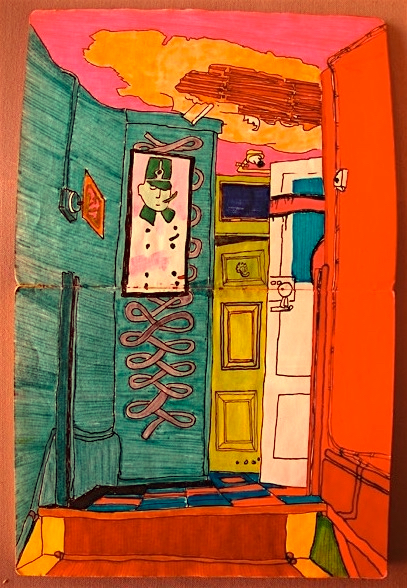
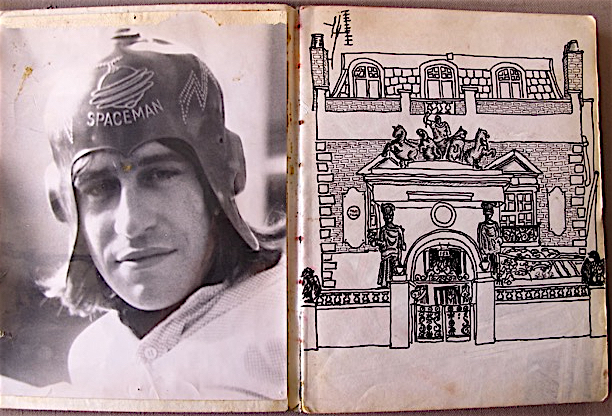
Birgitta visited The Pheasantry and produced a series of drawings recording its interior and the creative environment surrounding its residents. In later correspondence, she referred to Robert documenting these drawings during a reunion in Los Angeles in the 1980s.
Her relationship with Robert is also reflected in the material surrounding her friendship with Martin Sharp and the Australian artistic community.
Jan Öqvist, another Swedish figure in this circle, photographed Birgitta working on the famous Eric Clapton crochet jacket. His photographs provide another perspective on the people and activities surrounding her London career.
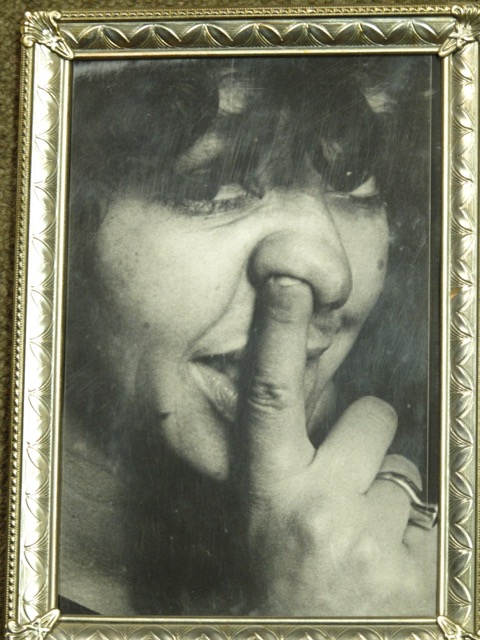
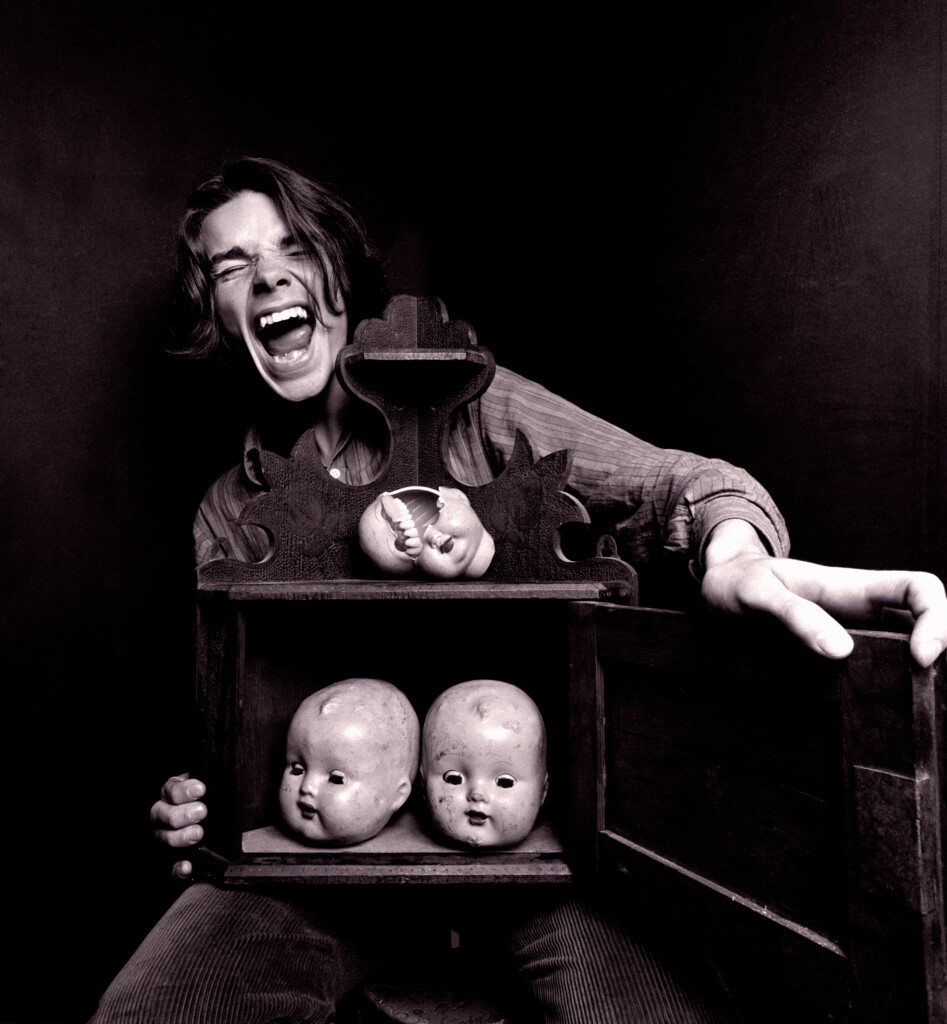
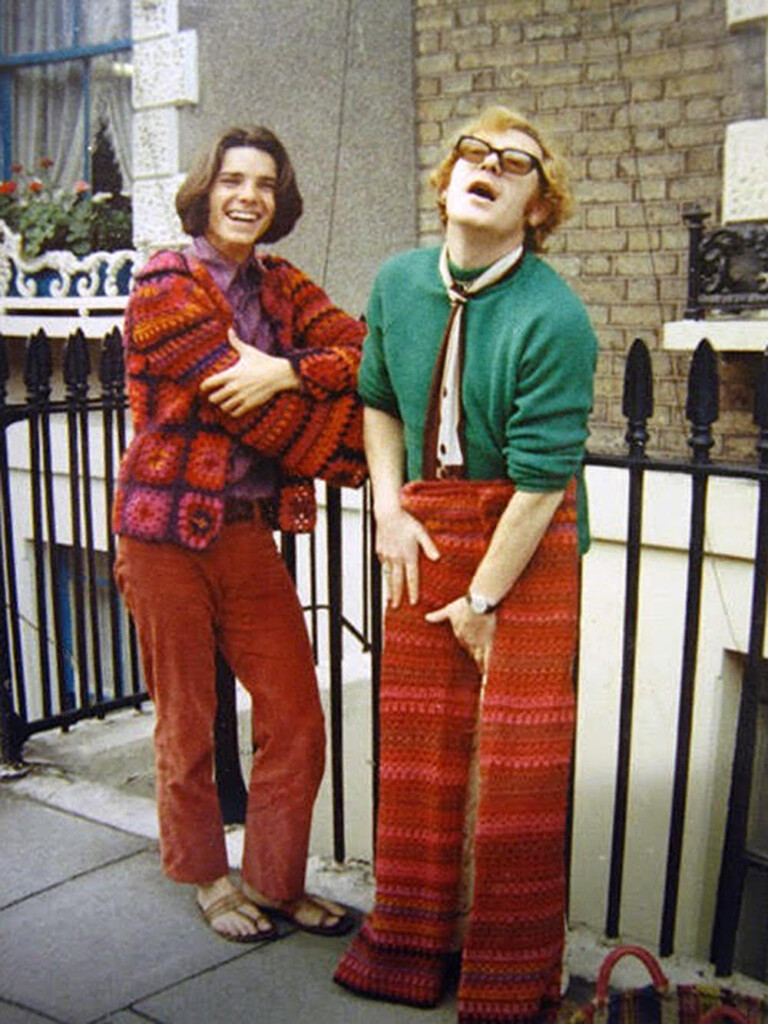
Paris: haute couture and the Mia and Vicky collection, 1969
In 1969, Birgitta’s work reached the Paris fashion world.
She became involved with the Mia and Vicky boutique, associated with Mia Fonssagrives, who was married to French fashion designer Louis Féraud.
Her designs were presented through the boutique, and the collaboration brought her work to a much wider fashion audience.
One particularly notable example was a crocheted dress worn by model Penelope Tree in Paris. The garment appeared in the fashion press, with Vogue crediting Louis Féraud as the designer.
Birgitta’s own account explains that the Mia and Vicky collection led to her subsequent collaboration with Féraud. She described the work as fantasy haute couture, an appropriate description for garments that combined experimental crochet with the theatrical qualities of high fashion.
She would return to work with Féraud in 1979, producing a second collection.
Unfortunately, many of the original garments from both collections have never been located. In her 1984 notes, Birgitta specifically expressed her frustration that the collections remained missing.
The surviving photographs and drawings therefore have considerable historical importance. Collectors Weekly+1
Ibiza: a new creative environment, 1969–1970
At the end of 1969, Birgitta left London and moved to Ibiza, Spain.
The island was becoming a destination for an international community of artists, musicians, writers and independent-minded travellers. Its relaxed atmosphere and distance from conventional European society offered an ideal environment for her continuing experiments with handmade clothing.
She continued to develop her crochet designs, creating colourful garments, swimsuits, dresses, hats and accessories.
Her work became part of the visual identity of the island’s bohemian community.
Among the people she encountered was photographer Karl Ferris, whose photographs documented the psychedelic music scene and its personalities.
One particularly memorable photograph, taken in spring 1970, shows Birgitta surrounded by friends wearing her colourful crochet creations. The group photograph provides a wonderful record of the 100% Birgitta aesthetic: individual garments brought together into an extraordinary collective display of colour and texture.
Birgitta later recalled gathering everyone together at 11 o’clock in the morning to dress in woollen garments, despite the warm Mediterranean climate.
She also returned to Britain during the summer of 1970 to attend the Bath Festival of Blues and Progressive Music and the Isle of Wight Festival.
Music, as she described it, was her food.
Island Records and Jimmy Cliff, 1970–1971
Birgitta’s work was not restricted to clothing and textiles.
Her artistic interests extended into illustration, painting and graphic design, and she also became involved in record-cover artwork.
Her 1984 curriculum vitae records work on an Island Records cover for Jamaican reggae musician Jimmy Cliff around 1970.
A particularly interesting surviving credit is Jimmy Cliff’s album Another Cycle, released in 1971. Album-credit listings associate Birgitta Bjerke with the cover design, artwork and photography.
This provides a tangible link between her work and the developing international reggae scene, as well as her continuing relationship with the music industry.
It is worth distinguishing the date in her personal career notes from the album’s release date: Another Cycle appeared in 1971, although her involvement may have begun in 1970. Collectors Weekly+1
San Francisco: murals, wearable art and the Grateful Dead, 1971–1975
In 1971, Birgitta moved to San Francisco, where she entered another important period of artistic experimentation.
The Bay Area had developed its own distinctive counterculture, with music, communal living, alternative businesses, political activism and handmade art all contributing to a new creative environment.
Birgitta began producing large-scale murals alongside her wearable art and painted T-shirts.
Her association with the Grateful Dead became another significant part of her story. In 1973, she worked on murals and clothing connected with the band and its surrounding community.
The connection between her textile work and the music scene was particularly natural. Clothing was not simply something to wear on stage; it became an extension of the performers’ identities and the wider visual culture surrounding their music.
In 1974, she became associated with the Cumquat May store in Marin County, California, a venture she references in her own biography alongside coverage in Rolling Stone magazine.
The following year, she developed one of her more ambitious projects: The Garden of Earthly Delights, a vegan restaurant in San Francisco.
Her description of the establishment is revealing. It combined organic food, live music, posters, hotel accommodation, restoration and interior decoration.
This was much more than a restaurant project. It brought together several of her interests in a single creative enterprise: art, hospitality, food, music and the design of physical environments.
She was also involved in creating posters for the live bands performing there.
Her 1984 notes refer to a four-page feature about her life and the restaurant in the San Francisco Chronicle Sunday supplement. That original article would be an especially valuable source to locate.
Sweden, Gotland and the Eagle Coat, 1976–1979
In 1976, Birgitta returned to Sweden and continued her work in record-cover design.
She collaborated with Metronome Records on artwork associated with Swedish musician Pugh Rogefeldt and his album Bamalama.
She also discovered Gotland, the Baltic island that would become an important part of her personal and artistic life.
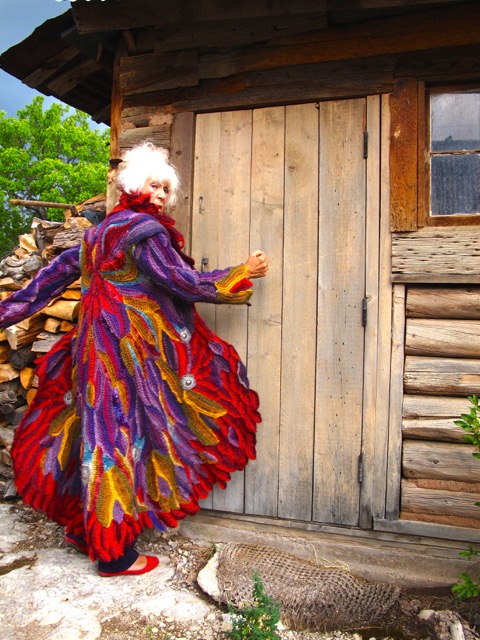
During this period, she began developing one of her most ambitious textile projects: Highflying Bird, better known as the Eagle Coat.
In 1977, she travelled to Santa Fe and worked for American photographer Laura Gilpin. She also undertook research for the Eagle Coat.
Returning to San Francisco, she continued working on the garment, combining textile craftsmanship with an increasingly ambitious artistic vision.
The completed work became a significant part of her identity as an artist.
In 1978, she exhibited Art as Clothing in Stockholm, with the Eagle Coat featured prominently in the exhibition publicity. The exhibition attracted considerable attention and demonstrated that her work had moved beyond fashion into the territory of contemporary textile and wearable art.
In 1979, she returned to Paris for a second fantasy haute couture collection with Louis Féraud.
Her career had now moved through fashion houses, rock stages, Mediterranean artistic communities, American counterculture and international exhibitions, all while retaining a recognisable personal style.
New Mexico and the film industry, 1980–1984
In 1980, Birgitta returned to America and settled in Santa Fe, New Mexico.
She continued developing her textile work, producing a collection for Handwoven Originals and exploring new directions in clothing and wearable art.
Her creativity also took her into the film industry.
In 1981, she worked as a production assistant and wardrobe assistant on Timerider: The Adventure of Lyle Swann, a science-fiction Western released in 1982.
Her next major film project was Paris, Texas, directed by Wim Wenders and released in 1984.
Birgitta was credited as costume designer on the film, starring Harry Dean Stanton, Nastassja Kinski and Dean Stockwell.
The film became one of the most celebrated works of Wenders’ career, winning the Palme d’Or at the 1984 Cannes Film Festival.
Her involvement in Paris, Texas marked another significant achievement in a career that had already encompassed fashion, music, fine art and textile design. Her costume-design credit is confirmed by the BFI and the Wim Wenders Foundation’s production documentation. BFI Southbank Programme Notes+1
In her 1984 biography, Birgitta also described herself as having approximately 500 crocheted and knitted pieces in existence at that time, most of which had been sold around the world.
She was already represented in the research library of the Museum of Contemporary Crafts in New York.
She described herself as self-taught in textiles, although her earlier formal studies had been in commercial art and design.
She had also been documenting her life photographically since the age of twelve, alongside her drawing, crochet and writing.
Later recognition and the 100% Birgitta exhibitions
In 2009, Birgitta’s work was brought together in a major retrospective, 100% Birgitta: The Fine Art of Revolutionary Crochet, at the Center of Southwest Studies at Fort Lewis College in Durango, Colorado.
The exhibition covered work spanning 1964–2008 and presented her career as an important contribution to fibre art, fashion and the handmade counterculture movement.
The accompanying exhibition and contemporary press coverage highlighted the extraordinary range of her work, from experimental garments and elaborate crochet to painting and political murals. swcenter.fortlewis.edu+1
Her work was subsequently included in the 2017 Counter-Couture: Handmade Fashion in an American Counterculture exhibition at the Museum of Arts and Design in New York.
This placed her alongside other influential makers who transformed handmade clothing into a form of artistic and cultural expression.
The retrospective also helped reconnect Birgitta with many of the people who had bought or worn her work decades earlier. She spent considerable time tracing garments around the world, recovering pieces for exhibition and reconstructing the history of her own creations.
Many of the original garments remain unlocated, including the Mia and Vicky and Louis Féraud collections.
Selected sources
- Collectors Weekly – Meet the Swedish Artist Who Hooked British Rock Royalty on Her Revolutionary Crochet. Particularly valuable interview with Birgitta and Jan Öqvist.
- Museum of Arts and Design – Counter-Couture, 2017. Institutional recognition of her work.
- Center of Southwest Studies – 100% Birgitta retrospective. Exhibition documentation covering 1964–2008.
- Durango Herald – Hooked, February 2009. Contemporary exhibition review.
- BFI – Paris, Texas production credits.
- Wim Wenders Foundation – Paris, Texas production documentation.