
Between the Mediterranean and the Middle East: a country on the threshold of change
In the summer of 1971, Robert Whitaker travelled to Lebanon, capturing a fascinating collection of images that offer a glimpse into a country at a particularly interesting moment in its history.
His photographs take us to Beirut, the Lebanese capital, where the Mediterranean lifestyle, international society, political intrigue and the complex realities of Middle Eastern politics existed side by side.
Looking through the photographs today, it is difficult not to be struck by the contrast between the Lebanon Robert encountered and the country that would emerge from the devastating civil war that began in 1975.
In 1971, Beirut was still widely regarded as one of the most cosmopolitan cities in the Middle East. It was a centre for international banking, commerce, publishing, journalism and culture. Its hotels, restaurants, beaches and nightclubs attracted visitors from Europe, the Gulf and further afield. French, English and Arabic could be heard throughout the city, reflecting Lebanon’s distinctive cultural character.
Yet beneath this outward confidence, the political landscape was becoming increasingly complicated. Robert’s photographs, taken just four years before the outbreak of the Lebanese Civil War, preserve an important visual record of this extraordinary period.
Beirut and the Saint Georges Yacht Motor Club
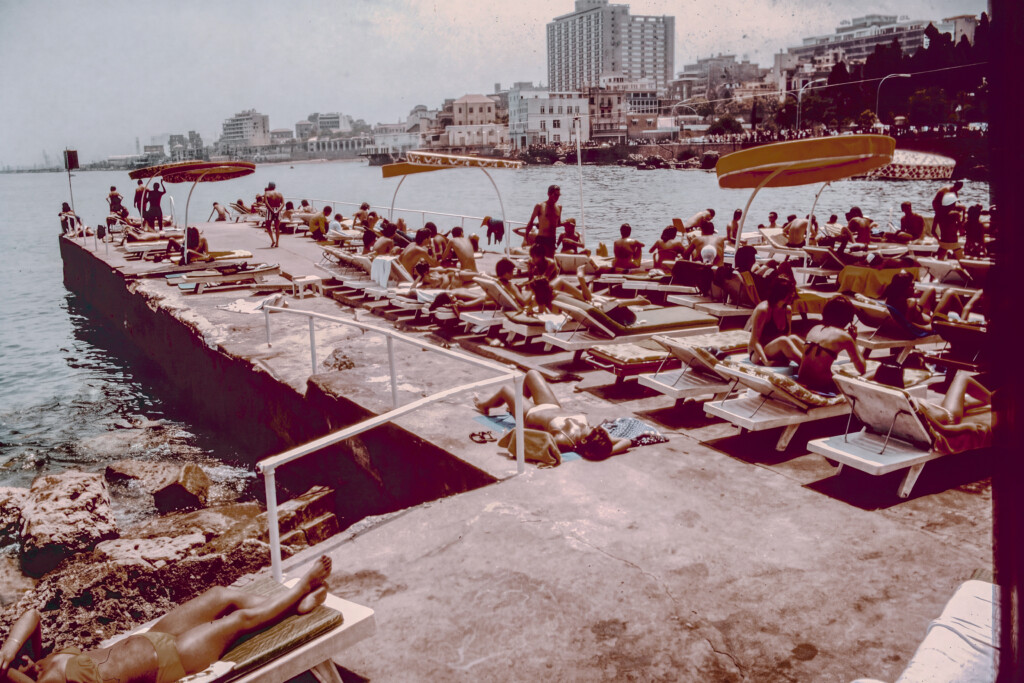
One of the most evocative settings in Robert’s collection is the Saint Georges Yacht Motor Club, on Beirut’s Mediterranean waterfront.
The Saint Georges was much more than a swimming club. It was an important part of Beirut’s social life, a meeting place for the city’s wealthy families, international visitors and fashionable society.
The bathing establishment first opened in 1932. In 1936, Michel Nader acquired it and established the Saint Georges Yacht Motor Club. Over the following decades it developed into one of the city’s best-known seaside destinations. Its facilities expanded to include beach cabins and, in 1968, the swimming pool that became such a familiar feature of the club. L’Orient-Le Jour+1
The adjoining Saint Georges Hotel was equally celebrated. Known for its elegant interiors, restaurant and bar, it became a gathering place for businessmen, diplomats, journalists and other influential visitors. Its interiors were designed with the involvement of celebrated French designer Jean Royère.
It was a place where Beirut’s international character was particularly apparent: a sophisticated Mediterranean meeting point where business, politics and leisure often overlapped.
Robert’s photographs of the club in the summer of 1971 capture this world at a time when Beirut still enjoyed its reputation as a glamorous destination.
The Hilton Hotel in the background
One particularly interesting detail in Robert’s photograph is the Hilton Hotel visible in the background.
The building is an important historical reference point. The original Beirut Hilton was intended to become one of the city’s major international hotels. It was scheduled to open in 1975, but the outbreak of the Lebanese Civil War prevented it from welcoming its first guests.
The hotel was completed shortly before the fighting began, but was caught up in the violence surrounding Beirut’s central hotel district. It never opened in its original form and was eventually demolished in 2002.
This makes Robert’s 1971 photograph particularly interesting. It records the Hilton as part of the changing Beirut skyline, several years before the building would become associated with the destruction of the city.
There is something especially poignant about seeing it in the background of an otherwise relaxed summer scene at the Saint Georges.
A meeting with Elias Sarkis
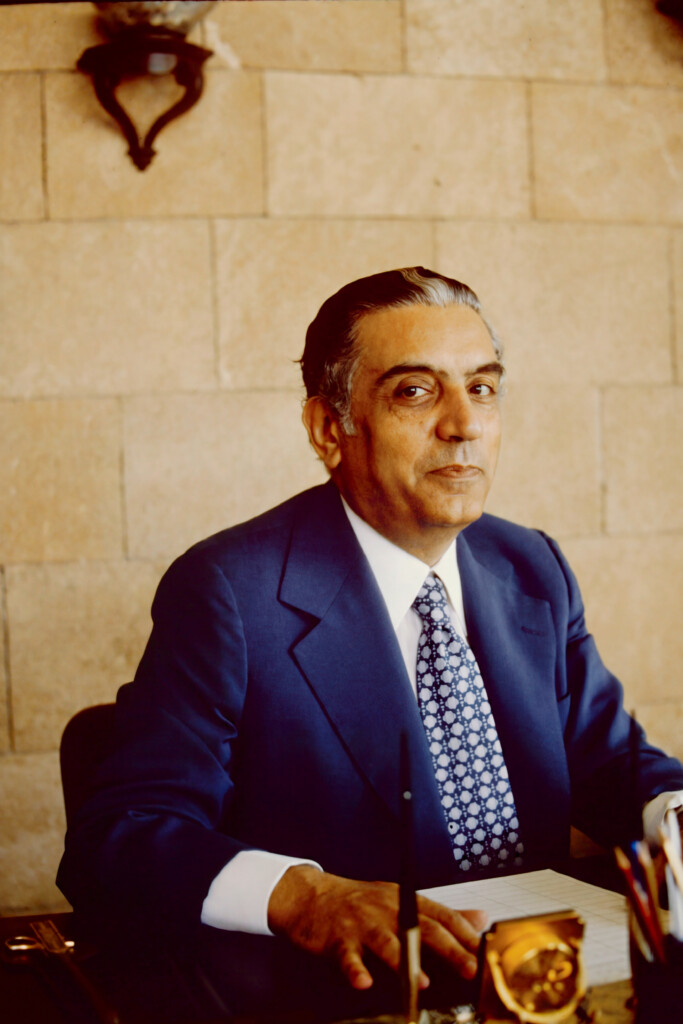
Among the more significant individuals identified in Robert’s Lebanese photographs is Élias Sarkis (1924–1985).
Sarkis was a Lebanese lawyer and senior public official who would later become the sixth President of Lebanon, serving from September 1976 until September 1982.
However, his position in 1971 is particularly important to the historical context of Robert’s photographs.
Sarkis had been appointed Governor of the Banque du Liban, Lebanon’s central bank, in June 1968. He held this position until 1976, when he resigned following his election as president. Governorate Timeline+1
He was therefore already an influential figure in Lebanese public life when Robert photographed him.
His earlier career had also brought him close to the Lebanese presidency. He had served as a legal adviser and senior official within the presidential administration, giving him considerable experience of the country’s political institutions.
Sarkis would eventually assume the presidency during one of the most difficult periods in Lebanon’s modern history. His election in May 1976 came after the civil war had already begun, and he formally took office in September that year.
The photograph in Robert’s archive therefore captures Sarkis several years before he became president, during his time as one of Lebanon’s most important financial and political figures.
It is an interesting example of the way Robert’s photography occasionally intersects with people and events that would later become significant historical reference points.
George Habash and the Palestinian political movement
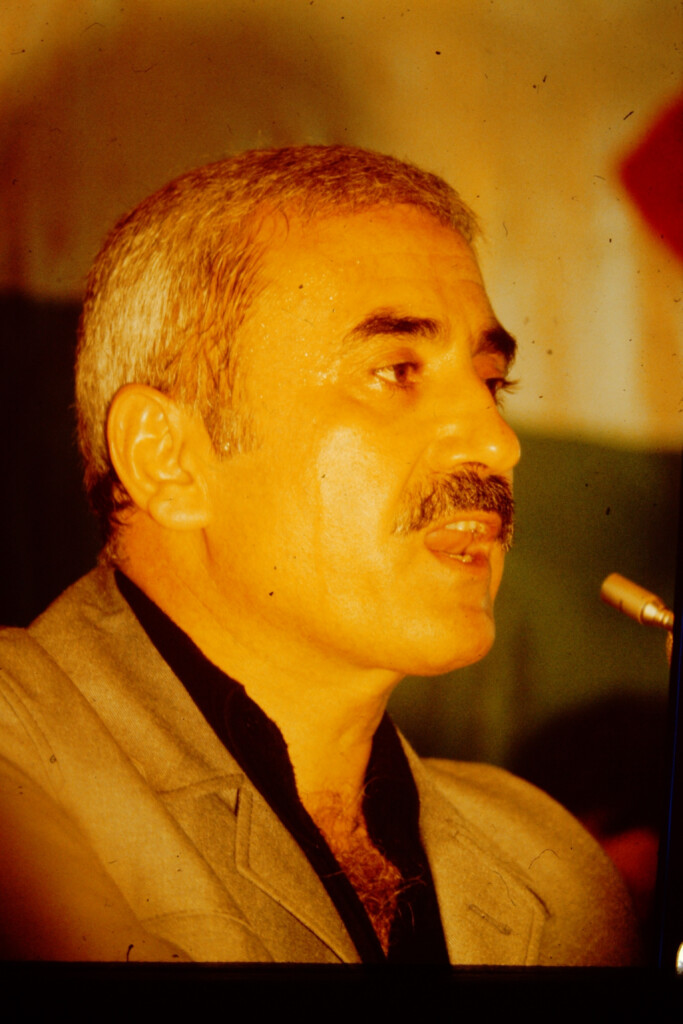
Another important political figure identified in Robert’s collection is George Habash (1925–2008), widely known by his honorific Al-Hakim, meaning ‘The Doctor’.
Habash was a physician by training and one of the most influential figures in the Palestinian nationalist movement.
Born in Lydda, Palestine, in 1925, he studied medicine at the American University of Beirut, graduating in 1951. His experiences surrounding the displacement of Palestinians in 1948 profoundly shaped his political outlook.
In December 1967, he founded the Popular Front for the Liberation of Palestine (PFLP), an organisation that became one of the most prominent factions within the wider Palestinian national movement.
Habash was a committed Arab nationalist who later adopted Marxist-Leninist political ideology. Under his leadership, the PFLP became internationally known for its revolutionary activities and its campaign for Palestinian liberation. george habash
His presence in the Lebanese story of 1971 is particularly significant.
Following the violent confrontation between Palestinian armed groups and the Jordanian government in 1970, commonly known as Black September, Palestinian fighters and political organisations increasingly shifted their activities to Lebanon.
The process continued through 1971, as the remaining Palestinian strongholds in Jordan were dismantled. Lebanon consequently became an increasingly important base for Palestinian political and military organisations.
Habash’s association with Beirut was longstanding, and he would spend much of the following decade in Lebanon.
An important dating consideration: Habash was active in Jordan during much of 1971, with the final withdrawal of Palestinian forces to Lebanon taking place towards the end of that year. The precise date of Robert’s photograph and the circumstances of the meeting would therefore be valuable in establishing its historical context.
The identification of Habash in Robert’s photograph gives the image particular significance, connecting the archive to one of the major political personalities of the period.
Baabda Palace – the seat of the Lebanese presidency
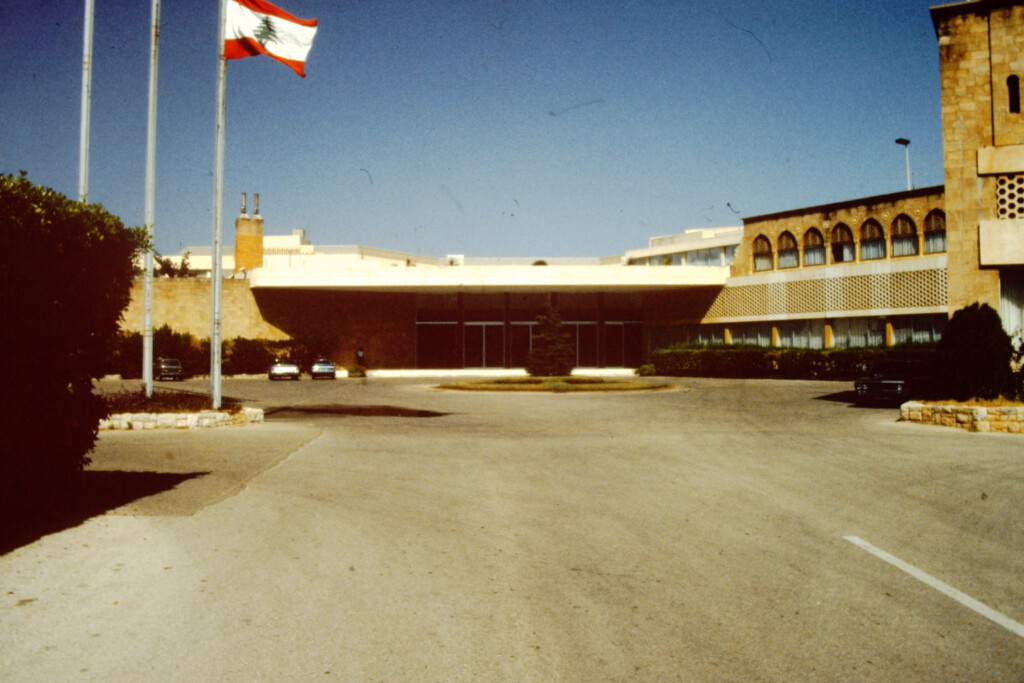
Robert’s photographs also include Baabda Palace, the official presidential palace of Lebanon.
Situated in Baabda, southeast of Beirut, the palace is an important landmark in the country’s political history.
The modern palace was developed during the presidency of Charles Hélou. The presidential administration moved into the new complex in early 1969, and the official transfer of power between Hélou and his successor, Suleiman Frangieh, took place there in September 1970. Presidency of the Lebanese Republic+1
Consequently, when Robert photographed the building in 1971, it was already the working seat of the Lebanese presidency.
The palace is particularly relevant to the photographs of Elias Sarkis. Although Sarkis would eventually occupy the building as president from 1976, he was still Governor of the Banque du Liban when Robert visited.
The architectural appearance of the palace in Robert’s photograph is also worth preserving. The original entrance and its modernist canopy provide a historical record of the building before the extensive damage it suffered during the Lebanese Civil War.
In March 1976, during the presidency of Suleiman Frangieh, the palace came under heavy bombardment and suffered substantial damage. It was subsequently repaired and redesigned.
Robert’s photograph therefore provides a valuable record of the palace in its original architectural form, before the destruction and reconstruction that would alter its appearance.
Beyond Beirut – a journey into Syria
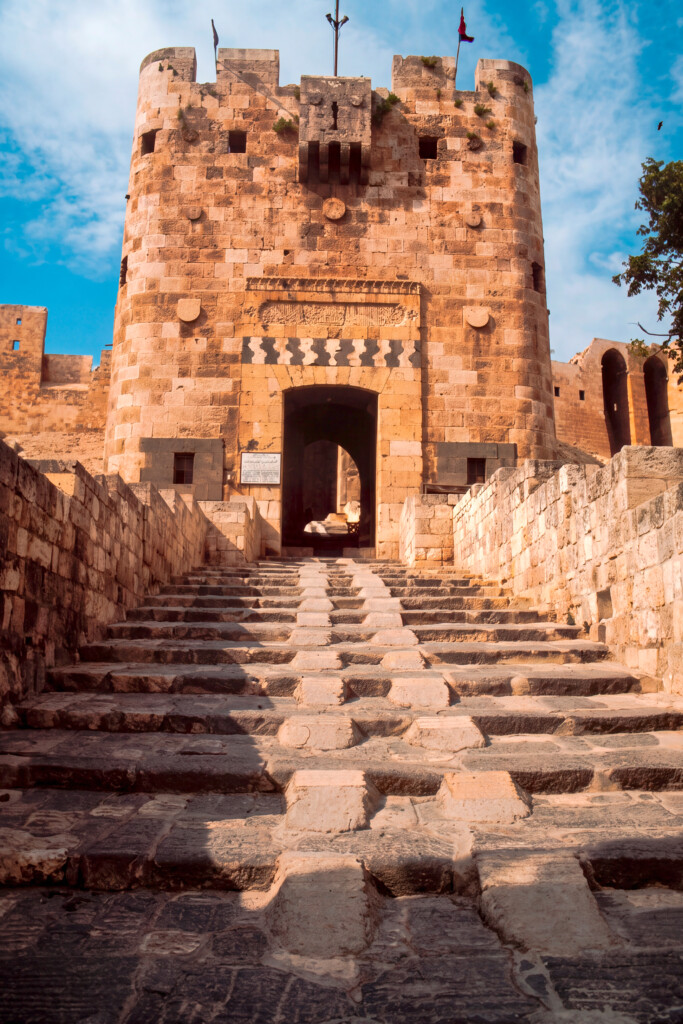
Robert’s collection also includes a photograph of the magnificent entrance to the Citadel of Aleppo.
Although this image was not taken in Lebanon, it is an interesting addition to the wider story of Robert’s travels in the region.
Aleppo, in northern Syria, is one of the oldest continuously inhabited urban centres in the world. Its position at the crossroads of important trading routes made it a major commercial and cultural centre for successive civilisations.
The citadel dominates the historic city from its elevated position. Its monumental entrance is particularly impressive, with a fortified stone bridge leading towards the main gate.
The surviving entrance complex was developed principally under the Ayyubid ruler al-Malik al-Zahir Ghazi during the late twelfth and early thirteenth centuries, with further additions during the Mamluk period.
Its distinctive defensive architecture includes alternating dark and light stonework, monumental gates, inscriptions and projecting defensive structures.
The photograph demonstrates Robert’s interest in architecture and historical places beyond the more familiar world of celebrity and portrait photography.
It also provides an intriguing indication that his travels may have extended beyond Beirut into neighbouring Syria, although the precise itinerary and date of this particular photograph remain to be established.
Lebanon on the eve of the Civil War
Perhaps the most important aspect of Robert’s Lebanese photographs is the historical moment they preserve.
In 1971, Lebanon was experiencing a period of considerable political uncertainty, despite its continued economic and cultural prominence.
The 1969 Cairo Agreement had recognised a degree of freedom for Palestinian armed organisations to operate from Lebanon, particularly in the south. Following the events of Black September in Jordan, the arrival of additional Palestinian fighters and political organisations further complicated the country’s internal politics.
Lebanese society was increasingly divided over the Palestinian presence, the country’s relationship with its Arab neighbours and the question of national sovereignty.
These tensions would intensify over the following years, eventually contributing to the outbreak of civil war in April 1975.
For Robert, however, the summer of 1971 was an opportunity to photograph a country that was still very much alive with international visitors, Mediterranean glamour and cultural exchange.
His photographs capture different sides of Lebanon: the fashionable social world of the Saint Georges Yacht Motor Club, the political personalities who would shape the country’s future, the architecture of its presidential institutions and the wider historical landscape of the region.
Looking at these images more than half a century later, we are reminded that photographs can become particularly important historical documents with the passage of time.
The Beirut of Robert’s photographs would change dramatically in the years that followed. The hotels, streets and gathering places that had defined the city’s international reputation would become associated with a prolonged and devastating conflict.
The Saint Georges itself, once a symbol of Beirut’s glamorous seaside life, would suffer during the war, as would much of the surrounding waterfront.
Robert’s 1971 photographs preserve something that cannot be recreated: a moment in the life of Lebanon before the events that would transform it.
For the Robert Whitaker Archive, this collection is particularly interesting because it extends the story of Robert’s work beyond the music, personalities and cultural figures for which he is perhaps best remembered. It demonstrates his interest in people, places, architecture and the wider world around him.
These are not simply photographs of a holiday destination. They are a visual record of Lebanon at a fascinating turning point in its history.
Research references
- Presidency of the Lebanese Republic – Elias Sarkis.
- Banque du Liban – Governorate historical timeline.
- PalQuest – George Habash biography.
- L’Orient-Le Jour – The history of the Saint Georges.
- Lebanese Presidency – History of the presidential palaces.
- UNESCO – Ancient City of Aleppo.
- A Deal With the Devil – The Political Economy of Lebanon, 1943–75.