

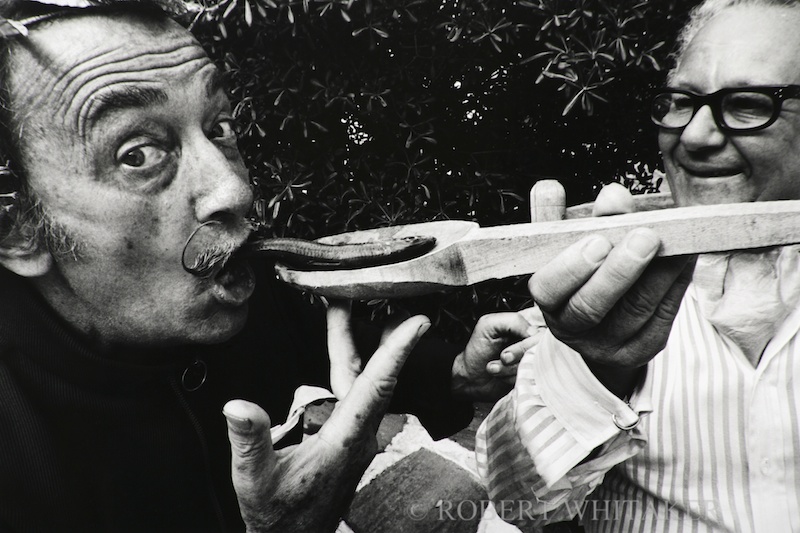
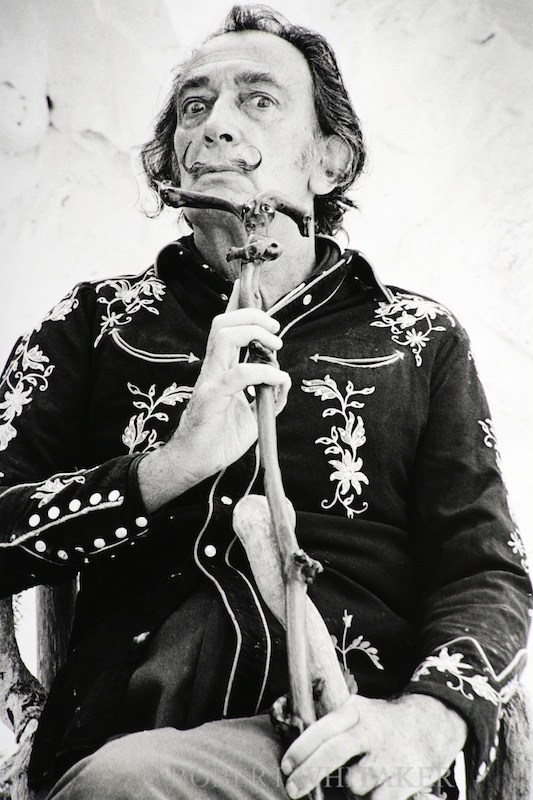
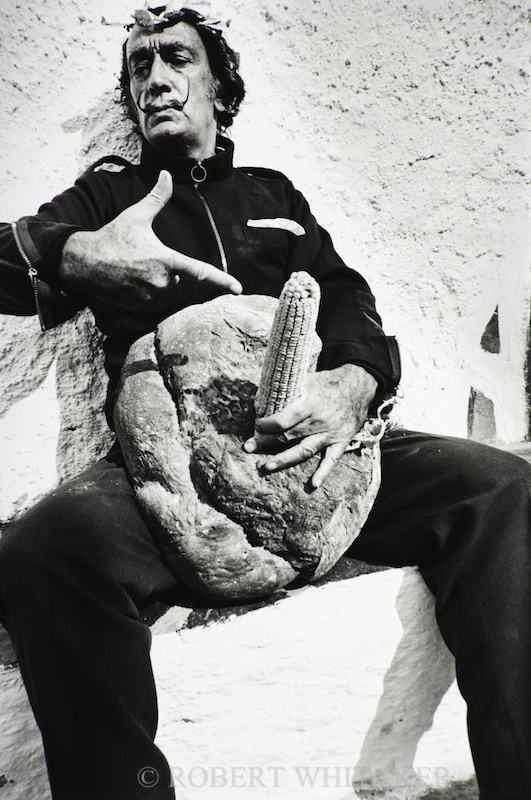

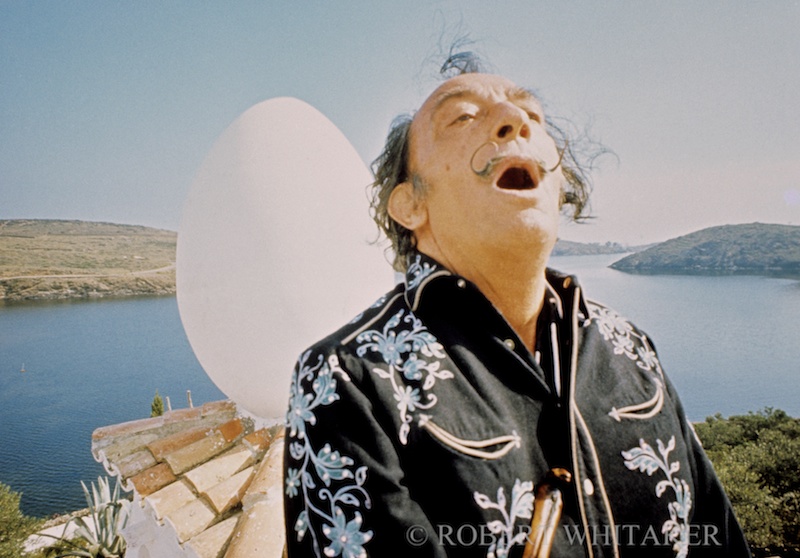
“Pictures, let’s take lots of pictures. I love being photographed by a sympathetic person. I am the greatest prostitute in posing for pictures in the world”. These were Dali’s first words to me when I was taken to meet him by Douglas Cooper in 1967.
Few relationships in Robert Whitaker’s photographic career were as unusual, creatively stimulating and personally rewarding as his friendship with the legendary Spanish artist Salvador Dalí. Their association brought together two distinctly unconventional creative minds, united by a shared fascination with imagery, experimentation, provocation and the unexpected.
For Robert, Dalí was more than simply another celebrated subject to photograph. He was an artist whose work had fascinated him since childhood and whose approach to creativity would leave a lasting impression on his own photographic thinking.
A fascination that began in childhood
Robert’s interest in Salvador Dalí began long before they ever met. At the age of sixteen, he was given a book about the artist and became captivated by his extraordinary imagination and surrealist approach to the world.
Inspired by what he had seen, Robert created a Dalí-inspired collage and sent it to the artist. Dalí was sufficiently impressed to invite the young Robert to visit him at his home. Although they would not meet in person until several years later, this early connection marked the beginning of a fascination that would eventually develop into a remarkable friendship.
By 1967, Robert had established himself as a successful photographer, having documented the emerging British music scene and produced some of the most recognisable images of The Beatles. It was through the art historian, collector and Dalí associate Douglas Cooper that Robert and Dalí finally met.
The introduction proved to be the beginning of a creative relationship that would continue for the next five years. Dali exhibitions+1
Inside the world of Salvador Dalí
Between 1967 and 1972, Robert visited Dalí on numerous occasions, photographing him both at his home and studio in Portlligat, on the Catalonian coast of Spain, and during visits to Paris.
Portlligat was Dalí’s personal sanctuary and creative world. His home, a collection of interconnected fishermen’s cottages overlooking the Mediterranean, was filled with unusual objects, artistic curiosities and carefully arranged theatrical details. It was an environment that seemed almost tailor-made for Robert’s photographic imagination.
Their relationship quickly developed beyond that of photographer and subject. Dalí enjoyed Robert’s company, and the two shared an appreciation for humour, eccentricity and artistic experimentation.
Robert was given an unusually intimate insight into Dalí’s private world. He witnessed extravagant celebrations, artistic experiments and moments of the artist at work. Rather than simply documenting Dalí from a distance, Robert was able to explore the personality behind the public spectacle.
Many of the resulting photographs were carefully staged, with Dalí actively participating in the visual ideas. There was a shared understanding that a portrait did not necessarily need to represent reality in the conventional sense. It could be playful, provocative, theatrical or completely unexpected.
This creative partnership produced a remarkable collection of photographs that captured not only Dalí’s distinctive appearance but also his extraordinary personality.
Getting inside Dalí’s mind
Perhaps the most revealing example of Robert’s experimental approach came from his desire to photograph Dalí in a completely different way.
Robert was fascinated by the possibilities of close-up photography. Having experimented with extension tubes on his camera lenses, he was able to photograph subjects from extraordinarily close distances, revealing details that would ordinarily go unnoticed.
When explaining his idea to Dalí, Robert famously said that he wanted to get inside the artist’s head. He described his intention as photographing “inside every hole” he could find.
He began with Dalí’s ears, before moving on to his mouth and nose. It was an unconventional approach, but one that Dalí embraced with characteristic enthusiasm.
The resulting photographs challenged the traditional idea of a portrait. Rather than presenting Dalí as the familiar, instantly recognisable public figure, Robert explored the individual through an unusual collection of extreme details.
In 1972, Robert took this concept even further, creating an extraordinary composite portrait of Dalí using all 36 exposures on a single roll of film. Each frame concentrated on a different part of the artist’s face, and when brought together, they formed a single, unconventional photographic portrait.
It remains one of the most intriguing examples of Robert’s experimental work.
The influence of Dalí on Robert’s photography
Dalí’s influence on Robert extended beyond the photographs he made of the artist himself.
Robert had always been interested in pushing the boundaries of conventional photography. His experiences with Dalí provided an opportunity to explore ideas that went beyond straightforward portraiture and documentary photography.
Dalí’s surrealist philosophy encouraged the viewer to question what they were seeing. Ordinary objects could become extraordinary, familiar forms could be transformed, and the unexpected could become the central feature of an image.
These ideas resonated with Robert’s own creative instincts. His photographs frequently combined humour, visual experimentation, unusual perspectives and a willingness to challenge expectations.
The extreme close-up experiments with Dalí also provided the foundations for a photographic concept Robert would revisit almost thirty years later.
He eventually developed what he called the Whitograph: a technique in which all 36 exposures on a roll of film were used to create a single composite image of a subject. Robert subsequently applied this approach to other artists and personalities, demonstrating how an experiment born from his time with Dalí continued to influence his work decades later.
In this respect, Dalí was not simply the subject of some of Robert’s most interesting photographs. He was also part of the inspiration behind a distinctive photographic technique that Robert would make his own.
A lasting photographic legacy
The importance of Robert’s photographs was formally recognised in 2017 when the Fundació Gala-Salvador Dalí acquired a substantial collection of his photographs of the artist, together with the associated reproduction rights.
The following year, the Foundation presented an exhibition entitled Salvador Dalí. Robert Whitaker. 1967–1972 at the Dalí Theatre-Museum in Figueres, Spain.
The exhibition brought together 27 photographs selected from Robert’s collection, many of which had never previously been exhibited together.
Among the images was a particularly interesting portrait of Dalí at the Hotel Meurice in Paris, with an iconic photograph of John Lennon visible in the background. It was an unexpected visual connection between two of Robert’s most significant photographic subjects: the world of The Beatles and that of Salvador Dalí.
The exhibition celebrated not only Robert’s ability to photograph one of the twentieth century’s most recognisable artists, but also the unusual friendship and creative understanding that developed between them.
The Foundation described their relationship as one of artistic and personal closeness, characterised by shared provocation and irony.
For Robert, the years spent photographing Salvador Dalí represented a particularly important chapter in his artistic development. Dalí had fascinated him as a teenager, welcomed him into his private world as an adult and helped inspire photographic experiments that would continue to evolve throughout his career.
Their friendship demonstrated that the relationship between photographer and subject could be much more than the act of capturing someone’s likeness. It could become a creative collaboration in which both individuals contributed to the final image.
Robert may have been behind the camera, but with Dalí, he found a subject who was every bit as imaginative, unconventional and willing to experiment as he was.
Research and archival notes
A few particularly useful details for the archive:
- 1967: Robert and Dalí finally meet through Douglas Cooper.
- 1967–1972: Robert photographs Dalí at Portlligat and in Paris.
- 1972: The extraordinary 36-frame composite portrait is created.
- 2017: The Dalí Foundation acquires Robert’s photographic collection.
- 2018: The Dalí Theatre-Museum presents the dedicated exhibition of Robert’s photographs.
An important distinction: The Dalí Foundation’s exhibition material confirms the childhood collage, invitation, introduction through Douglas Cooper, friendship and subsequent photographic work. It also provides an excellent independent institutional record of the relationship.
Principal sources:
- Fundació Gala-Salvador Dalí – Salvador Dalí. Robert Whitaker. 1967–1972
- Dalí Foundation – Exhibition of portraits of Salvador Dalí by Robert Whitaker
- Robert Whitaker Photography – Whitographs
For more images of Salvador Dali and Licensing inquiries please contact: Gala-Salvador Dali Foundation. www.salvador-dali.org