
Liverpool’s Merseybeat generation | 1964
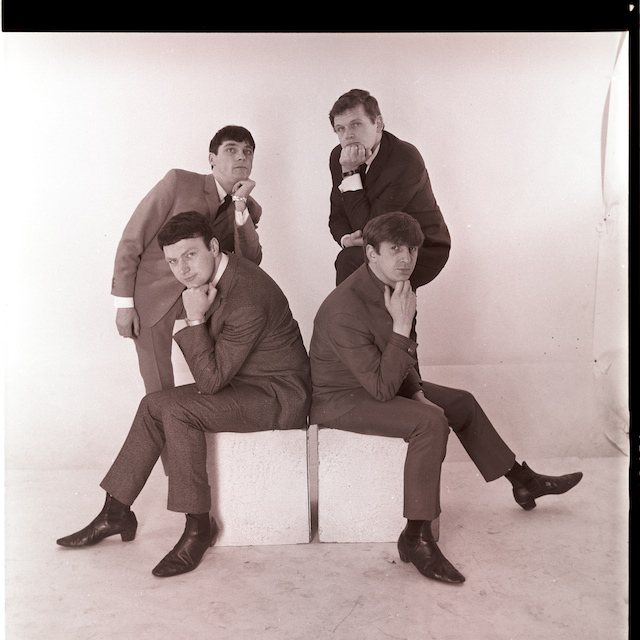
Brian O’Hara · Mike Millward · Billy Hatton · Dave Lovelady
In 1964, The Fourmost were among the established names of the British Merseybeat movement. Emerging from Liverpool’s vibrant club scene, the quartet had become part of Brian Epstein’s expanding stable of artists, alongside The Beatles, Gerry and the Pacemakers, Billy J. Kramer and the Dakotas, and Cilla Black.
Robert Whitaker’s studio portrait captures the group’s original line-up during a particularly successful period in their career. Arranged together in a carefully composed pose, the four musicians present a more formal image than the energetic performances that had helped establish their reputation in Liverpool.
From Liverpool to the national charts
The Fourmost’s origins can be traced to the late 1950s, when guitarist and vocalist Brian O’Hara formed a group that would eventually develop into The Four Jays. Following several personnel changes and the arrival of Mike Millward and drummer Dave Lovelady, the band adopted the name The Fourmost in 1962.
The original line-up comprised Brian O’Hara on lead guitar and vocals, Mike Millward on rhythm guitar and vocals, Billy Hatton on bass and vocals, and Dave Lovelady on drums.
Like many Liverpool groups of the period, The Fourmost developed their reputation through regular performances at local venues, including the Cavern Club. Their energetic approach, vocal harmonies and distinctive personalities helped them attract attention within the increasingly competitive Merseybeat scene.
Their fortunes changed significantly when Brian Epstein took over their management in June 1963. Epstein’s influence and connections brought the group to the attention of EMI producer George Martin, and they secured a recording contract with Parlophone.
The Lennon and McCartney connection
One of the group’s greatest advantages was access to songs written by John Lennon and Paul McCartney.
Their debut single, Hello Little Girl, released in August 1963, was one of Lennon’s earliest compositions. It reached number nine in the British singles chart, giving The Fourmost an immediate national profile.
Their follow-up, I’m in Love, another Lennon-McCartney composition, was released in November 1963 and reached number 17.
These recordings established an interesting connection between The Fourmost and The Beatles. While the Beatles were developing their own international recording career, their compositions were also helping introduce other Epstein-managed artists to the British record-buying public.
A Little Loving – 1964
The group’s greatest commercial success came in the spring of 1964 with A Little Loving.
Written by Russ Alquist, the song was released on Parlophone in April and became The Fourmost’s biggest British hit, reaching number six in the UK singles chart. It remained in the chart for thirteen weeks.
The record demonstrated that the group could succeed beyond their association with Lennon and McCartney compositions, establishing an identity of their own within the crowded British pop market.
Further releases followed during 1964, including How Can I Tell Her and their version of the Four Tops’ American soul hit Baby I Need Your Loving.
The latter recording demonstrated the group’s willingness to explore the growing influence of American soul music, which was becoming increasingly important to British pop.
Brian Epstein’s Liverpool stable
The Fourmost occupied an interesting position within Brian Epstein’s musical organisation.
Although they never achieved the international success of The Beatles, they were part of the same extraordinary generation of Liverpool performers who transformed British popular music during the early 1960s.
Their association with Epstein brought opportunities for national television appearances, recording sessions and performances alongside some of the most successful acts of the period.
They also appeared in the 1964 film Ferry Cross the Mersey, alongside Gerry and the Pacemakers, Cilla Black and other Liverpool performers, providing a further record of the close musical relationships within Epstein’s stable.
Robert Whitaker’s photograph
Robert Whitaker’s 1964 studio portrait documents Brian O’Hara, Mike Millward, Billy Hatton and Dave Lovelady during the height of the Merseybeat era.
The carefully arranged composition presents the four musicians together, offering a glimpse of the personalities behind a group whose success had grown out of Liverpool’s thriving live music scene.
Today, the photograph provides a visual record of a significant period in British popular music, when Liverpool groups were enjoying unprecedented national attention and Brian Epstein’s influence extended well beyond the success of The Beatles.
The Fourmost continued performing through subsequent decades, although their original partnership was eventually broken by the death of Mike Millward in 1966.
Their recordings remain part of the musical legacy of the Merseybeat generation, and their story offers another perspective on the remarkable network of artists who emerged from Liverpool during the 1960s.
Photo © Robert Whitaker
Research references
- Official Charts – A Little Loving – confirms the number six peak and 1964 chart history.
- Disc magazine, 26 October 1963 – contemporary group interview and original line-up photograph.
- National Portrait Gallery – Brian Epstein with The Fourmost – independently documents all four musicians.
- AllMusic – The Fourmost biography – recording history and musical background.
- Bill Harry’s Sixties – The Fourmost – useful Liverpool music history.