Robert Whitaker, Sean Connery and Sidney Lumet: Behind the scenes of a dark British psychological thriller
In the spring of 1972, Robert Whitaker was photographing the production of The Offence, a powerful and uncompromising British psychological drama directed by the acclaimed American filmmaker Sidney Lumet and starring Sean Connery.
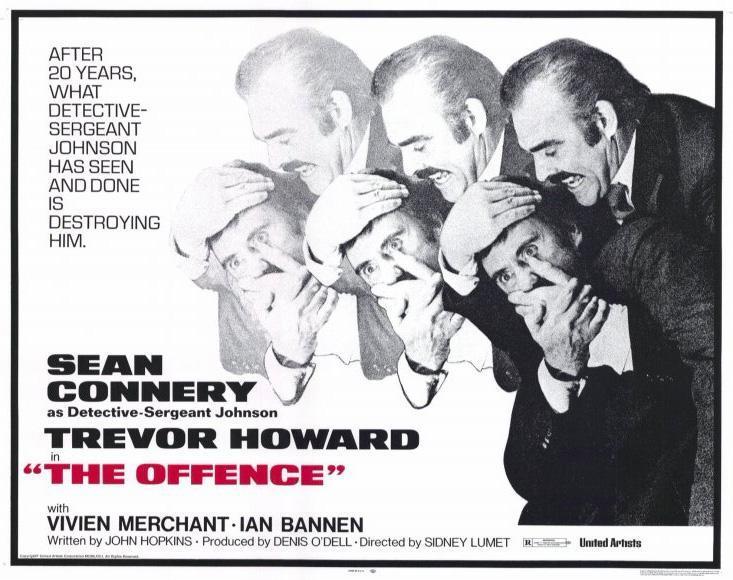
Filmed in and around Bracknell, Berkshire, the production brought together an exceptional group of actors and filmmakers. Alongside Connery were Trevor Howard, Vivien Merchant and Ian Bannen, in a story that explored the psychological consequences of violence, the pressures of police work and the disturbing boundaries between justice and revenge.
For Robert, the assignment provided an opportunity to photograph one of the most important actors of his generation, working on a film that was very different from the glamorous world of James Bond for which Connery had become internationally famous.
The surviving photographs in the Robert Whitaker archive offer a fascinating glimpse behind the scenes, documenting Connery, the director and fellow cast members during the making of this remarkable film.
Sean Connery: Beyond James Bond
By the early 1970s, Sean Connery was one of the biggest international stars in cinema.
His portrayal of James Bond had made him a household name, beginning with Dr. No in 1962 and continuing through several hugely successful films. Yet Connery was increasingly interested in taking on more challenging roles that would demonstrate his abilities beyond the world of action and espionage.
The Offence was an important part of that ambition.
Rather than playing a sophisticated secret agent, Connery took on the role of Detective Sergeant Johnson, a deeply troubled and emotionally exhausted British police officer whose years investigating violent crimes have taken a devastating toll.
It was an extraordinary departure from the polished, confident character audiences associated with Bond.
Connery’s performance is raw, uncomfortable and psychologically demanding. He portrays a man struggling with his own anger, memories and increasingly fragile sense of control.
The role gave him an opportunity to demonstrate a much darker and more complex side of his acting.
Sidney Lumet: A director fascinated by human behaviour
The film was directed by Sidney Lumet, one of the most respected filmmakers of his generation.
Born in Philadelphia in 1924, Lumet began his career in theatre and television before establishing himself as a major film director.
He was particularly interested in stories involving moral conflict, institutional pressure and the psychological complexities of ordinary people placed in extraordinary situations.
His earlier films included 12 Angry Men (1957), Serpico (1973), Dog Day Afternoon (1975) and Network (1976).
Lumet had already worked with Connery on The Hill (1965) and The Anderson Tapes (1971). Their professional relationship was clearly productive, and The Offence gave them an opportunity to explore much darker material.
Lumet’s approach was characteristically direct. He avoided unnecessary glamour, preferring to concentrate on performances, dialogue and the emotional pressure within a scene.
This made him particularly suited to John Hopkins’ original story.
The story: A detective pushed beyond his limits
The Offence is based on the stage play This Story of Yours, written by John Hopkins and first performed in London in 1968.
Connery plays Detective Sergeant Johnson, a veteran police officer investigating a series of serious sexual assaults involving young girls in a suburban town.
After years of exposure to disturbing crimes, Johnson has become increasingly cynical, angry and psychologically damaged.
When a suspect, Kenneth Baxter, played by Ian Bannen, is brought in for questioning, Johnson conducts an increasingly aggressive interrogation.
The encounter escalates into violence, with Johnson beating Baxter so severely that the situation becomes impossible to justify.
The film then examines Johnson’s actions and the psychological forces that have brought him to this point.
Trevor Howard plays Superintendent Cartwright, who is tasked with investigating the incident and questioning Johnson about his behaviour.
Through a series of flashbacks and confrontations, the film gradually reveals the detective’s troubled state of mind.
It is not a conventional police thriller. Instead, it is an uncomfortable examination of violence, authority, morality and the psychological consequences of confronting human cruelty over many years.
An exceptional British cast
Alongside Connery, the film featured some of Britain’s finest acting talent.
Trevor Howard played Superintendent Cartwright, bringing his familiar authority and understated intensity to the role. Howard was already an established star, with an impressive career stretching back to Brief Encounter (1945), The Third Man (1949) and numerous other distinguished productions.
Vivien Merchant played Maureen Johnson, the detective’s wife. A highly regarded stage and screen actress, Merchant was particularly admired for her work in Harold Pinter’s plays. Her performance provides an important insight into the private consequences of Johnson’s deteriorating mental state.
Ian Bannen played Kenneth Baxter, the man whose interrogation becomes the central event of the film.
Bannen was an accomplished Scottish actor with a reputation for portraying complex and often unpredictable characters. His scenes with Connery are among the film’s most powerful.
The supporting cast included Peter Bowles, Derek Newark, Ronald Radd and John Hallam.
The combination of these actors gave Lumet an exceptionally strong ensemble with which to explore the film’s difficult subject matter.
Bracknell: A modern town becomes a film location
One of the most interesting aspects of The Offence is its use of Bracknell, Berkshire, as the setting for much of the story.
During the late 1960s and early 1970s, Bracknell was undergoing considerable development as one of Britain’s designated New Towns. Its modernist architecture, concrete structures, pedestrian underpasses and newly constructed residential developments provided an unusual visual environment for a crime drama.
Rather than using traditional London streets or familiar urban settings, Lumet made effective use of Bracknell’s contemporary architecture.
The town’s distinctive buildings and public spaces created an atmosphere that was both modern and strangely impersonal, reinforcing the film’s themes of alienation and psychological unease.
Locations included:
- Bracknell Library, whose building doubled as the exterior of the police headquarters.
- Point Royal, in Easthampstead, used for the apartment block where Johnson lives.
- Wildridings and Crossfell, where scenes involving the local school and surrounding residential areas were filmed.
- The town centre, much of which has since been redeveloped.
The use of Bracknell is now regarded as one of the film’s most distinctive features. In 2023, the British Film Institute revisited the locations in an article examining the relationship between the film’s brutalist architecture and its unsettling atmosphere.
Robert Whitaker on the production
Robert’s involvement in The Offence is particularly well documented. He was credited as the film’s still photographer, a significant detail confirmed by the American Film Institute’s production records.
The photographs preserved in the Robert Whitaker archive provide a fascinating record of the production.
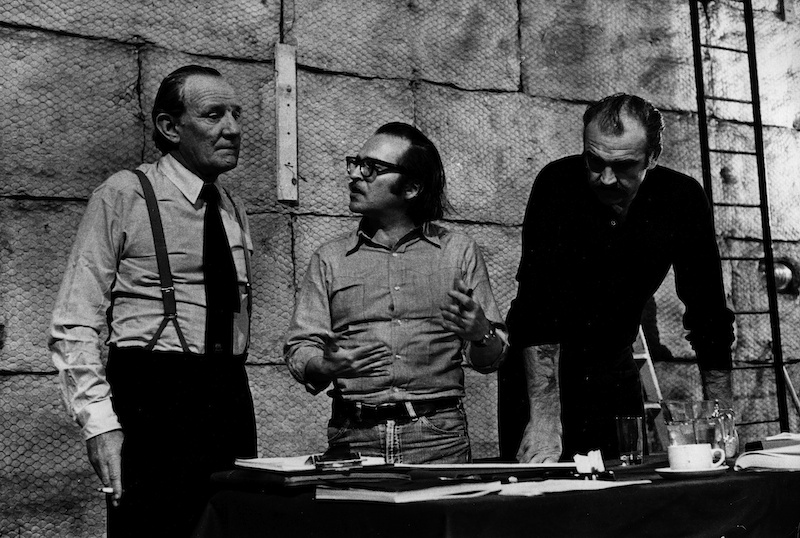
Among the images are photographs of Sean Connery as Detective Sergeant Johnson, as well as a particularly interesting behind-the-scenes photograph showing a script discussion between Connery, Trevor Howard and director Sidney Lumet.
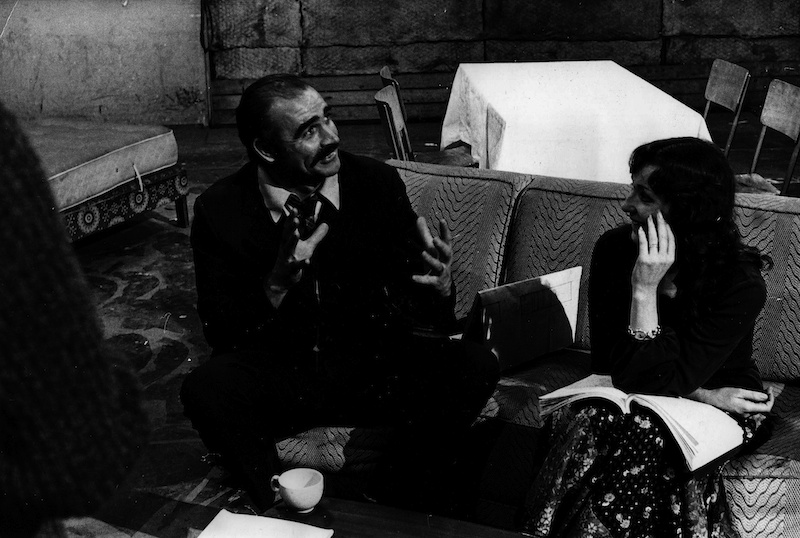
Another photograph captures Connery rehearsing his role with Vivien Merchant, who played his wife, Maureen Johnson.
These images offer something beyond conventional publicity portraits. They provide a glimpse of the working relationship between the actors and director, showing the preparation and concentration involved in bringing such a demanding screenplay to life.
For Robert, this was another opportunity to photograph an internationally recognised actor in a very different environment from the one in which audiences usually encountered him.
Connery’s performance required considerable emotional intensity, and the photographs give us a glimpse of the actor at work rather than simply presenting the familiar image of a Hollywood star.
A remarkable creative team behind the camera
The film’s cinematography was handled by Gerry Fisher, whose career included collaborations with several major British directors.
The production design was by John W. Clark, while the editing was undertaken by John Victor-Smith.
The musical score was composed by Harrison Birtwistle, one of Britain’s most important contemporary classical composers. His experimental approach contributed to the film’s unusual atmosphere, avoiding the conventional orchestral treatment associated with many crime dramas.
The production was made by Tantallon Films, Sean Connery’s own production company, with Denis O’Dell as producer. Connery was also involved as an executive producer.
The working title was Something Like the Truth, a phrase taken from John Hopkins’ original play. It was an appropriate title for a film concerned with the difficulty of understanding people’s actions and motivations.
The release and legacy
The Offence was released in 1973 by United Artists.
Although it did not achieve the commercial success of Connery’s Bond films, it received considerable critical attention and has subsequently developed a strong reputation among admirers of serious British cinema.
Its uncompromising subject matter and challenging performances made it a very different proposition from mainstream entertainment.
Connery’s performance is frequently regarded as one of the finest of his career, demonstrating an emotional range that audiences did not always associate with the actor.
Lumet’s direction also gives the film a remarkable intensity. The combination of restrained cinematography, powerful performances and the stark architecture of Bracknell creates an atmosphere that remains disturbing and compelling.
Today, the film is particularly interesting to revisit because it captures a specific moment in British social and architectural history, as well as an important stage in Connery’s career.